

Updating website content is defined as the regular practice of revising, expanding, and correcting your site’s pages to keep information accurate, competitive, and visible in search results. For small and medium-sized business owners, the reasons to refresh content go far beyond fixing typos. Content decay affects 60% of web pages within 12 months, causing an average traffic loss of 37%. That figure means a page ranking well today can quietly bleed visitors for months before you notice the drop. The rise of AI-powered search engines like Google’s AI Overviews and Perplexity has made content freshness even more critical, rewarding recently updated pages with citations and penalizing stale ones with invisibility.
Why update website content: what happens when you don’t
Content decay is the gradual loss of search rankings and organic traffic that occurs when a page is no longer updated. It is not a sudden crash. It is a slow erosion caused by competitors publishing better content, statistics becoming outdated, and search intent shifting over time.
The consequences are measurable and serious:
- Traffic loss: 60% of web content experiences decay within 12 months, with an average 37% drop in traffic. That is more than a third of your visitors gone without a single algorithm penalty.
- Citation loss: Unrefreshed pages experience three times more citation loss over time than pages on active refresh schedules. This means your content stops being referenced by other sites and AI engines alike.
- User trust: Visitors who find outdated statistics, broken links, or prices from three years ago leave immediately. That exit signals low quality to Google, compounding the ranking drop.
- AI exclusion: AI-generated answers often exclude pages not updated recently, even when the content is otherwise thorough and well-structured.
The impact of outdated website content is not limited to search rankings. It affects how potential customers perceive your business. A page showing a 2021 case study or a discontinued product tells visitors your business is not paying attention. That perception is hard to recover from without a deliberate refresh program.
How do AI search engines change the need for fresh content?

AI search engines prioritize content freshness far more aggressively than traditional search algorithms. Google’s AI Overviews, Perplexity, and similar tools pull from a narrow freshness window when assembling answers for users.
73% of AI Overview citations reference content published or updated within the last six months. Perplexity’s citation rate for recent content reaches 81%. Those numbers reveal a clear pattern: if your page has not been touched in over six months, AI engines are likely skipping it entirely.
Traditional SEO allowed a longer grace period. A well-structured page could hold rankings for 12 to 18 months with minimal changes. AI-driven search compresses that window dramatically. The practical implication for your business is that content which once ranked passively now requires active maintenance to stay visible.
| Update cadence | Traditional SEO impact | AI search impact |
|---|---|---|
| Every 30–45 days | Moderate ranking signal | Strong citation inclusion |
| Every 6 months | Acceptable for stable topics | Risk of AI exclusion |
| Over 12 months | Significant ranking decay | Near-certain AI exclusion |
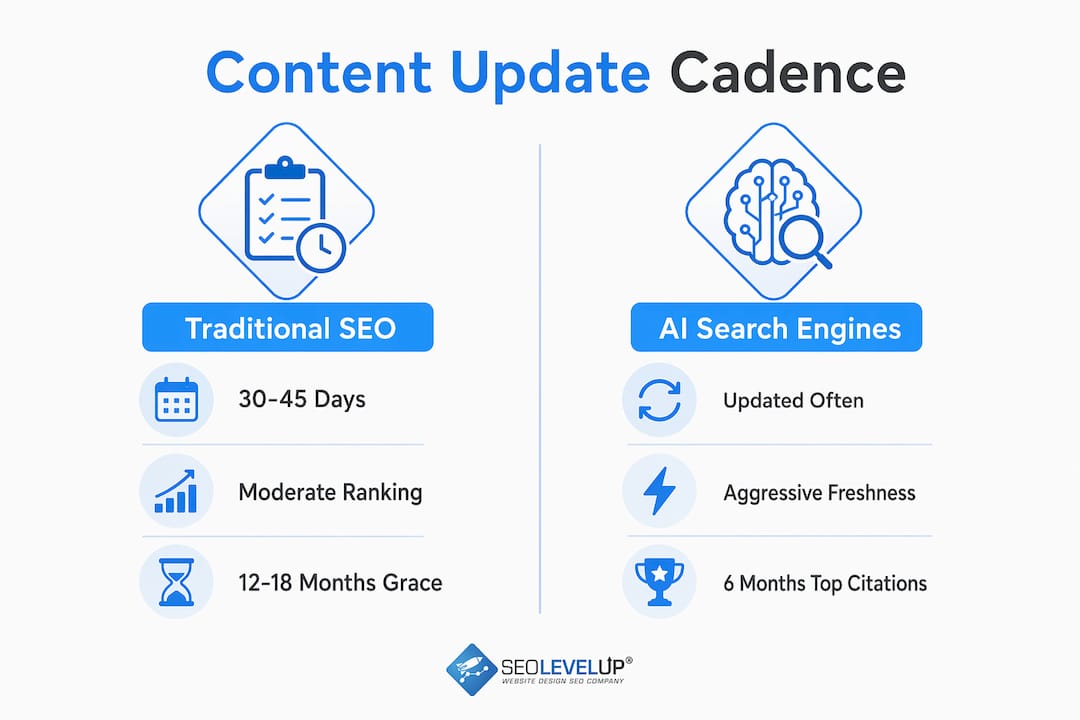
AI search engines favor fresher content more than traditional search, requiring updates every 30–45 days to stay included in AI citations and answer engines. For SMBs competing against larger brands with dedicated content teams, this cadence is not optional. It is the new baseline for AI search visibility.
Pro Tip: Set a calendar reminder every 30 days to review your top five traffic pages. Check for outdated statistics, broken links, and any claims that no longer reflect your current services or pricing.
How often should small to medium-sized businesses update their content?
The right update frequency depends on your industry, the type of content, and how competitive your market is. Not every page needs the same attention on the same schedule.
-
High-priority service and product pages: Update every 30–45 days. These pages drive conversions and are the most likely targets for AI citation. Even small changes, such as adding a recent client result or refreshing a statistic, signal freshness to search engines.
-
Blog posts and educational articles: Review every 3–6 months. Check whether the core information is still accurate, whether newer data has replaced your cited statistics, and whether the search intent behind the topic has shifted.
-
Industry-specific pages: SaaS product pages become materially outdated within 4.2 months on average. B2B service pages hold relevance for roughly 8.7 months. Use these benchmarks to set realistic review cycles for your specific business type.
-
Location and contact pages: Review quarterly. Incorrect addresses, phone numbers, or service areas are among the fastest ways to lose local search trust.
-
Case studies and testimonials: Update at least twice per year. Adding recent results keeps these pages credible and gives Google a freshness signal on pages that rarely change otherwise.
The most common mistake SMBs make is updating content randomly, without a schedule or a clear reason. A page updated because someone “felt like it” without diagnosing why it is underperforming rarely recovers. Strategic refresh cycles tied to performance data produce results. Random edits do not.
Pro Tip: Use Google Search Console to identify pages with declining impressions over the past 90 days. Those are your highest-priority refresh candidates, not the pages you happen to remember.
What are the best practices for refreshing website content effectively?
Effective content refreshing follows a diagnosis-first process. Updating content without understanding why it is underperforming wastes time and often fails to recover rankings.
Diagnose before you write
Full diagnosis of traffic loss causes is critical before any refresh begins. A page losing traffic because of a search intent mismatch needs restructuring, not just new paragraphs added to the bottom. A page losing traffic because a competitor published a more detailed version needs depth improvements. Treating every decay problem the same way produces inconsistent results.
Update statistics and references
Outdated numbers are one of the fastest ways to lose credibility with both readers and search engines. Replace any statistic older than 12 months with current data. Update references to tools, regulations, or industry standards that may have changed. Fresh content signals on-page freshness to search engines via date stamps, recent statistics, and updated references, directly impacting rankings and AI citations.
Improve structure and depth
If a page ranked well but has slipped, check whether competitors now cover the topic more thoroughly. Add sections that answer related questions your audience is searching for. Use clear H2 and H3 headings to improve scannability. Structured data, including schema markup, helps search engines understand your updated content faster. You can learn more about how structured data supports SEO and why it matters for refreshed pages.
Measure the impact
Track performance changes after every refresh using Google Analytics and Google Search Console. A well-executed refresh of an existing high-ranking page can produce a 50–300% increase in traffic within three months. That return outperforms new content creation in most cases, making content refreshing one of the highest-ROI activities available to SMBs.
| Refresh action | Expected outcome | Timeline |
|---|---|---|
| Update statistics and dates | Improved freshness signals | 2–4 weeks |
| Restructure for search intent | Recovered rankings | 4–8 weeks |
| Add depth and new sections | Increased time on page | 4–6 weeks |
| Fix broken links and technical errors | Reduced bounce rate | 1–2 weeks |
Key Takeaways
Refreshing website content on a structured schedule is the single most effective way for SMBs to recover lost traffic, maintain AI citation inclusion, and build lasting user trust.
| Point | Details |
|---|---|
| Content decay is measurable | 60% of pages lose an average of 37% of traffic within 12 months without updates. |
| AI search demands faster cycles | 73% of AI Overview citations favor content updated within the last six months. |
| Diagnose before refreshing | Identify the cause of decay first; intent mismatches require restructuring, not just new text. |
| Update frequency varies by type | Service pages need 30–45 day cycles; blog posts can be reviewed every 3–6 months. |
| Refreshes outperform new content | A structured refresh can deliver 50–300% more traffic within three months. |
What I’ve learned from watching SMBs ignore content decay
I have worked with enough small business owners to know that content updates are almost always the last item on the list. The website gets built, it ranks for a few months, and then everyone moves on to the next project. That pattern is expensive.
The part that surprises most business owners is how fast AI search has changed the rules. A page that held its position for two years under traditional SEO can disappear from AI-generated answers within 60 days of going stale. That is not a hypothetical. I have seen it happen to service pages that were genuinely well-written and well-structured. The content was good. It just was not recent.
The other mistake I see constantly is treating a refresh as a writing project instead of a diagnostic one. Business owners add a few paragraphs, change the date, and expect rankings to recover. When they don’t, the conclusion is that “content updates don’t work.” The real problem is that the update never addressed why the page was declining. A page losing traffic because it no longer matches search intent needs a structural overhaul, not a word count increase.
My honest recommendation: build a content calendar the same way you build a sales pipeline. Assign pages to review cycles, track their performance monthly, and treat a declining page as a business problem that needs a root cause, not a quick fix. The SMBs that grow organic traffic consistently are the ones that treat content maintenance as an ongoing operation, not a one-time event.
— Tommy Seilheimer
How SEOLEVELUP, LLC can help you keep your site competitive
Your website is your most valuable sales tool, and stale content quietly costs you customers every month. SEOLEVELUP, LLC Website Design SEO Company works with small and medium-sized businesses across Chicagoland to build fast, custom websites and maintain them with structured content refresh strategies, SEO, and GEO (Generative Engine Optimization) so your pages stay visible in both Google and AI-powered search results.
Whether you need a full site overhaul or a targeted content refresh program, SEOLEVELUP, LLC Website Design SEO Company has the team and the process to get it done. Our custom website design and development services include content strategy built for long-term search performance. Call (224) 600-4353 for a free SEO audit and find out exactly which pages on your site are losing ground right now.
FAQ
What does updating website content actually mean?
Updating website content means revising existing pages to correct outdated information, improve depth, and align with current search intent. It includes refreshing statistics, restructuring headings, fixing broken links, and adding new sections where needed.
How often should I update my website content?
High-priority service pages benefit from updates every 30–45 days to maintain AI citation inclusion. Blog posts and educational articles should be reviewed every 3–6 months based on performance data from Google Search Console.
What is content decay and why does it matter?
Content decay is the gradual loss of rankings and traffic that occurs when a page is no longer updated. Research shows 60% of web content experiences decay within 12 months, with an average traffic loss of 37%.
Will updating old content improve my Google rankings?
A structured refresh of an existing page can produce a 50–300% increase in traffic within three months, outperforming new content creation in ROI for most SMBs.
Why do AI search engines care about content freshness?
AI search engines like Google’s AI Overviews and Perplexity heavily favor recently updated content. 73% of AI Overview citations reference content updated within the last six months, meaning stale pages are routinely excluded from AI-generated answers.


