

Google ranking is the position your website holds in Google’s search results when a potential customer types a query related to your products or services. Why does Google ranking matter? Because your position on that results page determines whether customers find you or your competitor first. Google processes 8.5 billion searches daily, making it the single most powerful discovery channel available to small and medium-sized businesses. Search engine optimization (SEO) is the recognized industry practice behind improving those rankings, and understanding how it works is the first step toward turning Google into a reliable source of new customers.
Why does Google ranking matter for website traffic?
Your ranking position on Google directly controls how much organic traffic your website receives. The difference between ranking on page one versus page two is not marginal. Studies consistently show that the first page of Google captures the overwhelming majority of clicks, with positions one through three receiving the largest share. Businesses that rank outside the top ten are effectively invisible to most searchers, regardless of how good their product or service actually is.

The quality of traffic from high rankings is just as significant as the volume. When someone searches “emergency plumber Chicago” or “best accountant near me,” they are expressing clear buying intent. Ranking at the top for those queries puts your business in front of people who are ready to spend money, not just browsing. That is why organic search drives more qualified leads than most other digital channels, including social media and display advertising.
Trust also plays a direct role in click-through rates. Searchers instinctively associate top Google rankings with credibility. A business appearing in position one is perceived as more authoritative than one buried on page three, even if the quality difference is minimal. Backlinks and domain authority remain strong trust signals that reinforce this perception with both Google’s algorithm and real customers.
Here is what the ranking-traffic relationship means in practical terms for your business:
- Position 1 to 3: Captures the majority of clicks for any given query, delivering the highest volume of organic visitors.
- Position 4 to 10: Still generates meaningful traffic, especially for high-volume keywords, but click share drops significantly with each step down.
- Page 2 and beyond: Receives less than 1% of total clicks for most queries. Ranking here is functionally equivalent to not ranking at all.
- Local pack results: Google’s map-based results appear above organic listings for local queries, making Google Maps rankings a separate but equally critical priority for brick-and-mortar businesses.
Pro Tip: Use Google Search Console to monitor your average position and click-through rate by query. If impressions are high but clicks are low, your title tags and meta descriptions may need revision before anything else.
How do Google rankings affect AI search visibility?
Ranking #1 on Google drives brand authority and AI citations even as AI-powered search tools reshape how results are displayed. This connection is not coincidental. AI models like those powering Google’s AI Overviews, ChatGPT, and Perplexity are trained on web data, and they consistently favor sources that already rank well on Google. Google rankings provide the foundational signals that AI models use to recognize a site as authoritative, which then influences citations across multiple platforms.
Answer Engine Optimization (AEO) is the emerging practice of structuring content so that AI systems cite your business when answering user questions. The important distinction from traditional SEO is that AEO focuses on being the source of an answer, not just a link in a list. However, the two practices share the same foundation. SEO’s foundational practices, including technical SEO, content depth, and structured data, are required for both ranking well on Google and appearing in AI-generated answers.
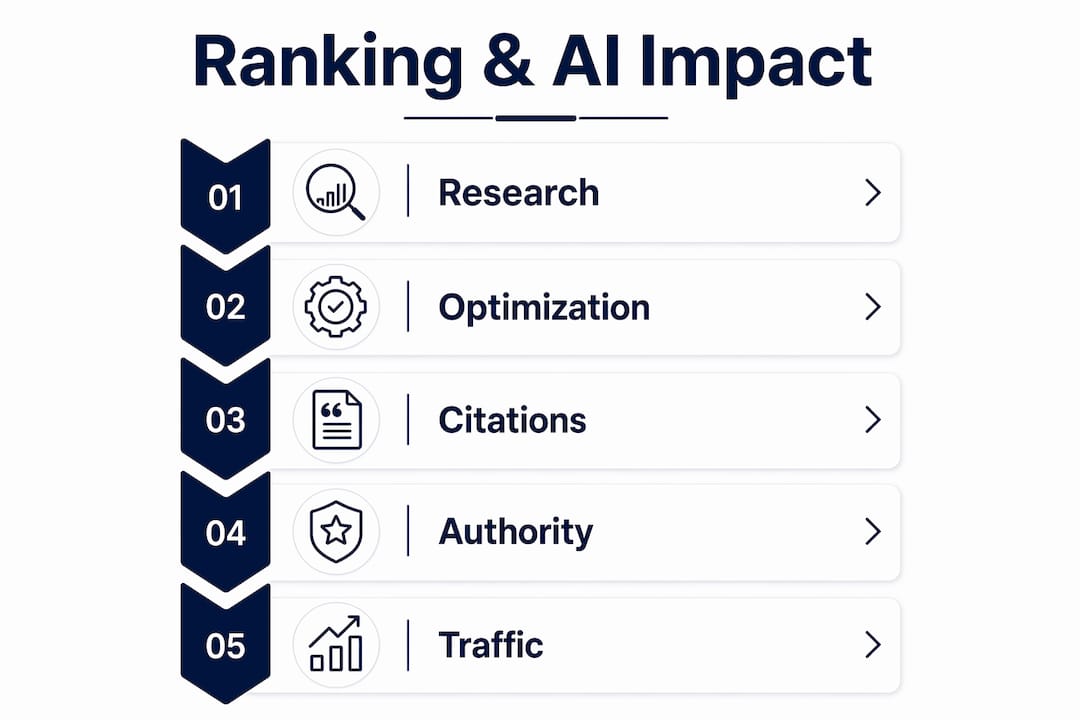
SEO is evolving from targeting ranking positions to also optimizing for AI-driven citation, which means businesses that invest in strong Google rankings today are also building the authority signals that AI systems will reference tomorrow. Ignoring rankings now creates a compounding disadvantage as AI search grows. The businesses that appear in AI Overviews and chatbot answers in 2026 are almost always the same businesses that already hold strong Google positions.
Pro Tip: Add structured data markup (Schema.org) to your service pages, FAQs, and business information. This formatting makes it significantly easier for both Google and AI systems to extract and cite your content accurately.
For a deeper look at how this hybrid approach works in practice, the Seolevelup guide on zero-click search optimization explains how to capture visibility even when users never click through to your site.
Common ranking challenges in 2026 and how to fix them
Understanding why rankings drop is as important as knowing why they matter. Many business owners misattribute traffic losses to AI Overviews when the actual cause is a technical SEO problem. AI Overviews appear on about 13 to 17% of US SERPs, concentrated heavily on informational queries. If your traffic drop is happening on commercial or transactional pages, AI Overviews are almost certainly not the cause.
Poor technical SEO like crawl errors or incorrect canonical tags can mimic the symptoms of an AI-driven traffic loss but require completely different fixes. A canonical tag pointing to the wrong URL tells Google to ignore your page entirely. A crawl blockage in your robots.txt file can prevent Google from indexing new content. These are fixable problems, but only if you diagnose them correctly.
Here is a structured approach to diagnosing and recovering from a ranking drop:
- Check Google Search Console first. Compare impressions versus clicks over the affected period. Search Console impression versus click patterns reveal whether your drop is from losing ranking positions or from AI-driven click suppression on queries where you still rank.
- Audit your technical SEO. Use tools like Google Search Console, Screaming Frog, or Semrush to identify crawl errors, broken internal links, and canonical tag issues.
- Segment your queries by intent. Separate informational queries from commercial and transactional ones. Google’s AI Overviews reduce click-through for informational queries by up to 30 to 60%, but commercial and transactional queries still drive the majority of clicks.
- Prioritize commercial content. Shift content investment toward product pages, service pages, and comparison content. High-intent commercial queries remain relatively unaffected by AI Overviews, making them the most stable traffic source.
- Verify your GA4 tracking setup. Measurement errors in Google Analytics 4 can make real traffic appear to have dropped. Cross-reference GA4 data with server-side logs before drawing conclusions.
| Issue type | Likely cause | Recovery action |
|---|---|---|
| Impressions down, clicks down | Ranking loss | Technical audit, content refresh |
| Impressions stable, clicks down | AI Overview CTR suppression | Add structured data, target commercial queries |
| Traffic down on specific pages | Crawl or canonical error | Fix in Search Console, resubmit sitemap |
| Sitewide traffic drop | Algorithm update or penalty | Comprehensive SEO audit, content quality review |
What are the long-term business benefits of high Google rankings?
SEO builds long-term digital assets that generate compounding traffic and revenue, unlike paid advertising that stops delivering the moment your budget runs out. A well-ranked page on Google can continue attracting customers for months or years with minimal additional investment. That compounding effect is what separates SEO from every other digital marketing channel in terms of long-term return on investment.
Successful businesses treat SEO as a strategic digital asset, aligning content structure and authority signals to build a sustainable growth engine. This means your website becomes more valuable over time, not less. Each new piece of well-optimized content, each earned backlink, and each technical improvement adds to a cumulative advantage that competitors without strong SEO cannot easily replicate.
The practical business benefits of maintaining high Google rankings include:
- Predictable lead generation: Organic rankings deliver a consistent flow of inbound inquiries without the cost variability of pay-per-click campaigns.
- Lower customer acquisition costs: Organic traffic costs nothing per click. Once a page ranks, the cost per lead drops significantly compared to Google Ads or Meta advertising.
- Brand authority in your market: Appearing at the top of search results for your core services signals market leadership to both customers and competitors.
- Strategic business intelligence: Data from Google Search Console and Google Analytics reveals exactly what your customers are searching for, which informs product development, pricing, and content decisions.
- Resilience against ad spend fluctuations: Businesses with strong organic rankings are not held hostage by rising ad costs or platform policy changes.
For a full breakdown of how these benefits connect to measurable business outcomes, the Seolevelup resource on SEO’s role in business growth covers the data in detail.
Key takeaways
Google ranking matters because it directly controls your business’s visibility, traffic quality, customer acquisition cost, and long-term digital authority.
| Point | Details |
|---|---|
| Rankings control traffic volume | Top three positions capture the majority of clicks; page two receives less than 1% of total clicks. |
| AI visibility depends on Google authority | Strong Google rankings are the foundation for being cited in AI Overviews and chatbot answers. |
| Not all traffic drops are equal | Distinguish between ranking loss, technical errors, and AI CTR suppression before choosing a fix. |
| Commercial queries remain stable | High-intent transactional queries are largely unaffected by AI Overviews, making them priority targets. |
| SEO compounds over time | Unlike paid ads, strong rankings build lasting digital assets that reduce acquisition costs year over year. |
The hybrid search reality most SMBs are not ready for
I have worked with enough small and medium-sized businesses to know that the most common misconception right now is that SEO is becoming less relevant because of AI. That belief is costing businesses real money.
The reality is the opposite. AI search tools do not replace Google rankings. They amplify them. The businesses getting cited in Google’s AI Overviews and in ChatGPT answers are the ones that already invested in strong, authoritative content and technical SEO. If you have not built that foundation, you are invisible in both traditional and AI-driven search.
What I tell every business owner I work with is this: stop treating SEO as a traffic tactic and start treating it as a credibility infrastructure. Your Google ranking is not just a number. It is a signal that tells every search engine, every AI model, and every potential customer whether your business is worth paying attention to. The businesses that understand this in 2026 will have a structural advantage that is very difficult for late movers to close.
The Google ranking factors guide from Seolevelup is a good starting point if you want to understand exactly what signals Google weighs most heavily right now.
— Tommy
Ready to improve your Google rankings?
Understanding the importance of Google ranking is the first step. Acting on it is what separates businesses that grow from those that stagnate. Seolevelup’s team of technical SEO specialists works specifically with small and medium-sized businesses to build the ranking authority, content depth, and technical foundation that drives consistent organic growth.
Whether you need managed local SEO services to dominate your city’s search results or a full search engine optimization strategy to compete at a national level, Seolevelup delivers verifiable results with transparent reporting. The team uses machine learning to analyze everything from site architecture to keyword frequency, giving your business a measurable edge. Contact Seolevelup today to find out exactly where your rankings stand and what it will take to move them.
FAQ
Why does Google ranking matter more than social media?
Google ranking captures users at the moment of active search intent, meaning they are already looking for what you sell. Social media reaches users passively, which produces lower conversion rates for most service-based businesses.
How does Google ranking affect my revenue directly?
Higher rankings increase the volume of qualified organic visitors to your site without a per-click cost, which lowers your customer acquisition cost and increases profit margin on each sale or lead.
Do AI Overviews make Google rankings less important?
No. AI Overviews appear on only 13 to 17% of US SERPs and primarily affect informational queries. Commercial and transactional queries, which drive the most revenue, are largely unaffected.
How long does it take to see results from improving Google rankings?
Most businesses see measurable ranking improvements within three to six months of consistent SEO work, though competitive markets may take longer. Technical fixes often produce faster results than content-based improvements.
What is the difference between SEO and Answer Engine Optimization?
SEO focuses on ranking in Google’s traditional blue-link results, while Answer Engine Optimization (AEO) focuses on being cited in AI-generated answers. Both rely on the same foundational practices, including technical SEO, content depth, and authoritative backlinks.


