
Search data analysis is the practice of collecting and interpreting user search behaviors to reveal real-time consumer needs, intent, and preferences. It gives business owners and marketers a direct window into what customers actually want, not what they say they want in a survey. 80% of consumers search before making a purchase, which means the answers to your biggest marketing questions already exist in search logs. The standard industry term for this practice is “search intelligence,” and it sits at the foundation of every effective SEO, content, and paid media strategy. Knowing why analyze search data matters is the first step toward building a marketing approach that responds to real demand.
Why analyze search data instead of using traditional research?
Search data captures what people type when no one is watching. That privacy makes it the most honest consumer intelligence available. Memory bias and social pressure make traditional surveys unreliable, but search data bypasses these filters entirely, delivering genuine behavioral intent.
Think about the difference between asking someone in a focus group what they worry about versus reading their actual search queries. In a focus group, participants edit themselves. They give answers that sound reasonable. In a search bar, they type “why does my knee hurt after sitting” or “cheapest way to fix a leaky roof.” Those queries reveal real fears, real budgets, and real decision triggers.
Search data is the most important dataset on human psychology ever collected. It captures authentic intent at the exact moment a person needs something, without the distortion of social performance or faulty memory.
Traditional market research also suffers from a sample problem. A focus group of 20 people tells you something. Search data operates at census scale, capturing millions of real decisions across every demographic simultaneously. That scale changes what you can conclude with confidence.
- Unfiltered intent: Searchers reveal problems they would never admit to a researcher.
- Real-time signals: Search volume shifts within days of a news event or seasonal change.
- Census-level scale: Patterns emerge from millions of queries, not dozens of survey responses.
- Language accuracy: You learn the exact words customers use, not the words your marketing team assumes they use.
Pro Tip: Map the exact phrases customers type into search engines and use that language verbatim in your headlines, product descriptions, and ad copy. Customers convert faster when they see their own words reflected back at them.
Understanding search intent is the bridge between raw query data and marketing decisions that actually move revenue.

What are the key benefits of analyzing search data for business growth?
Search data analysis produces benefits that compound over time. Each insight you extract feeds better content, sharper campaigns, and stronger positioning. The following five benefits represent the clearest return on the time you invest in this practice.
Spot trends before your competitors do. Search patterns surface emerging demand ahead of sales reports and industry publications. A spike in queries for “energy-efficient HVAC systems” in march tells an HVAC company to publish content and run ads before the summer rush, not during it. That timing advantage is real and measurable.
Identify unmet needs in your market. Zero-result queries in your site’s internal search logs show you exactly what visitors want that you do not currently offer. Search logs reveal content gaps and broken pathways with precision that no customer survey can match. Each gap is a product, service, or content opportunity waiting to be claimed.
Align messaging with real consumer language. When your website copy and ad headlines use the same phrases customers type into Google, friction drops. Intent-aligned messaging naturally increases conversions because customers feel immediately understood. This is not a theory. It is a pattern that shows up consistently across industries.
Find competitor gaps you can fill. Search data shows you what customers want that your competitors are not delivering. If a competitor ranks for “commercial cleaning Chicago” but has no content about “eco-friendly commercial cleaning Chicago,” that gap is yours to take.
Improve paid search efficiency. Keyword-level search data tells you which queries drive purchases versus which ones drive curiosity. Separating transactional intent from informational intent lets you allocate your ad budget to queries that convert, not just queries that generate clicks.
Pro Tip: Use keyword research techniques to segment your keyword list by intent type: informational, navigational, and transactional. Then build separate content and campaign strategies for each group.
What are the pitfalls to avoid when analyzing search data?
Most businesses collect search data but do not use it strategically. Almost none use it as a continuous feedback loop for content and marketing improvement. The reason is not a lack of data. It is a lack of analytical discipline.
The most common mistake is confirmation bias. Analysts look for queries that support a conclusion they already believe, and they ignore signals that challenge it. Disciplined interpretation requires naming your assumptions explicitly, separating raw observations from strategic recommendations, and including hypotheses that could disprove your conclusions.
A second pitfall is treating a correlation as a cause. A spike in searches for your brand name could mean a PR mention, a competitor’s ad campaign driving awareness, or a seasonal pattern. Attributing it to your latest blog post without checking other variables is a strategic error.
The table below contrasts disciplined analysis with common analytical errors:
| Disciplined approach | Common error |
|---|---|
| State assumptions before interpreting data | Interpret data to fit a preferred outcome |
| Separate observations from recommendations | Present interpretations as raw facts |
| Test disconfirming hypotheses | Seek only growth-aligned queries |
| Validate insights against sales and revenue | Stop at search volume as the success metric |
| Monitor trends over rolling periods | Draw conclusions from a single data snapshot |
- Avoid cherry-picking: Pull the full query set, not just the queries that support your pitch.
- Validate against hard outcomes: Search volume growth means nothing if revenue stays flat.
- Document your methodology: Write down what you measured, how, and why, so others can audit your conclusions.
Pro Tip: Before presenting any search data insight to a stakeholder, write down one hypothesis that would prove you wrong. If you cannot think of one, your analysis is not finished.
The role of analytics in SEO extends beyond keyword tracking. It requires the same rigor you would apply to any business intelligence function.
How can businesses apply search data insights to improve online visibility?
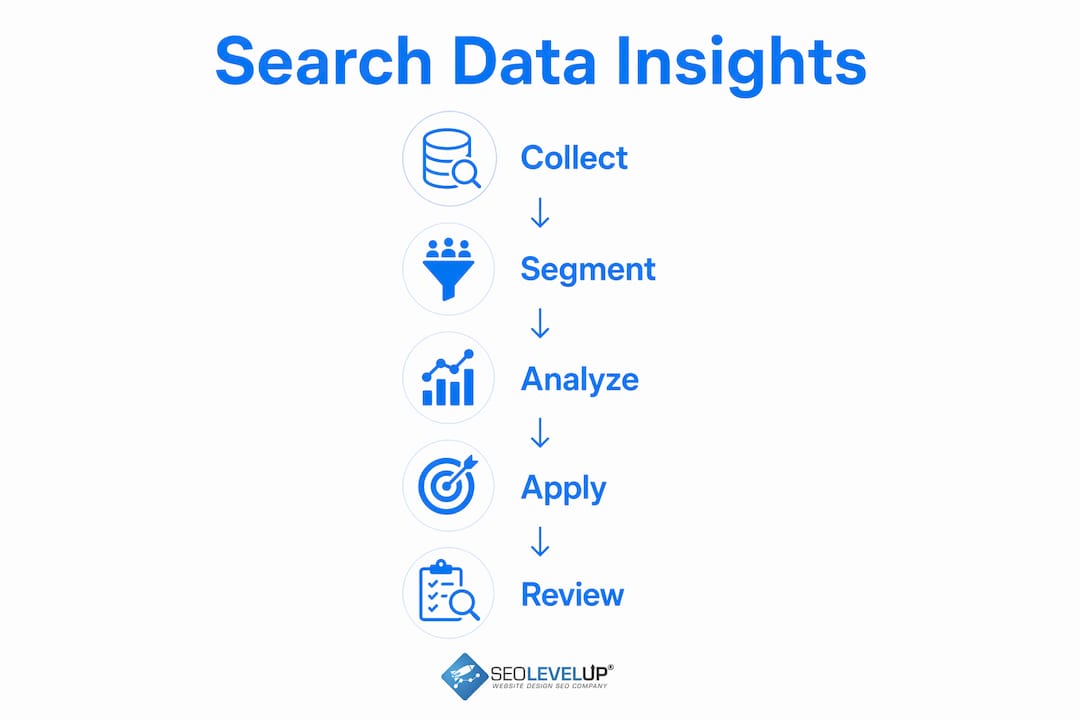
Applying search data insights follows a clear sequence. The sequence matters because skipping steps produces content that ranks but does not convert, or campaigns that drive traffic but attract the wrong audience.
Map search intent to content types. Informational queries (“how does local SEO work”) need educational articles or guides. Transactional queries (“local SEO company Chicago”) need service pages with clear calls to action. Matching content format to intent is the single highest-leverage application of search data.
Build a content calendar from trending queries. Pull rising search terms from Google Search Console or Google Trends monthly. Assign each trending topic to a content format and a publish date. This process turns reactive content creation into a planned editorial operation.
Address real customer pain points directly. Search queries are customer problems stated in plain language. A query like “why is my website not showing on Google” is a pain point. An article that answers it completely, with specific steps, earns trust and ranks for the query. Understanding search engine rankings starts with understanding the problems your customers are actively searching to solve.
Integrate search data into paid campaigns. Use high-converting organic keywords as the foundation of your paid search ad groups. Queries that already drive organic conversions are proven demand signals. Bidding on them in paid search accelerates results while your organic rankings build.
Monitor zero-click search opportunities. Featured snippets, People Also Ask boxes, and local map packs all pull from search data patterns. Structuring your content to answer specific questions directly positions you to capture these placements, which zero-click search strategies are built around.
Pro Tip: Review your Google Search Console data every 30 days. Look for queries where your page ranks in positions 5–15 but gets low click-through rates. Those pages need stronger title tags and meta descriptions, not new content.
Key Takeaways
Businesses that treat search data as a continuous intelligence asset consistently outperform those that rely on periodic surveys or intuition-based marketing decisions.
| Point | Details |
|---|---|
| Search data reveals true intent | Queries capture unfiltered consumer needs that surveys and focus groups cannot access. |
| Trend spotting drives timing advantage | Search patterns surface emerging demand before sales data or industry reports confirm it. |
| Analytical discipline prevents bias | Naming assumptions and testing disconfirming hypotheses keeps strategy grounded in evidence. |
| Intent mapping improves conversions | Aligning content format and messaging to query intent reduces friction and increases results. |
| Zero-result queries expose market gaps | Internal search logs show exactly what customers want that your current content does not provide. |
What search data taught me about listening before marketing
I spent years watching businesses pour budget into campaigns built around what they thought customers wanted. The messaging was polished. The creative was strong. The results were mediocre. The problem was always the same: the strategy started with the brand’s assumptions, not the customer’s actual words.
The shift happened when I started treating search data as the first input in every marketing decision, not a metric to check after the fact. When you read what people type into a search bar at 11 PM when they are worried about their business, you stop guessing and start responding. That is a fundamentally different posture, and it produces fundamentally different results.
The discipline part is harder than most people expect. It is tempting to look at a data set and find the story you want to tell. Analytical humility means writing down what the data actually says, separate from what you want it to mean, and then checking both against real business outcomes like revenue, leads, and customer retention.
My advice to any business owner reading this: run your search data analysis on a fixed schedule, document your methodology, and validate every insight against a hard business metric before you act on it. The businesses that do this consistently are the ones that compound their marketing advantage year over year.
— Tommy Seilheimer
How SEOLEVELUP, LLC Website Design SEO Company turns search insights into results

Search data is only as valuable as the strategy built around it. SEOLEVELUP, LLC Website Design SEO Company takes the insights buried in your search data and turns them into websites, content, and campaigns that drive real business growth. The team builds custom websites and managed SEO services designed around the exact queries your customers are already typing. From local SEO management and Google Business Profile optimization to schema markup and GEO, every service is grounded in what search data actually reveals about your market. Trusted with 165+ five-star reviews and heard on ESPN1000, SEOLEVELUP, LLC Website Design SEO Company delivers verifiable results, not just rankings. Call (224) 600-4353 for a free SEO audit.
FAQ
Why analyze search data instead of running customer surveys?
Search data captures what people type privately, without social pressure or memory bias, making it more accurate than survey responses. It also operates at a scale that no survey sample can match.
What can search data reveal about my competitors?
Search data shows which queries your competitors rank for and which gaps they leave uncovered. Those gaps represent direct opportunities to create content or services that capture unmet demand.
How often should I review my search data?
A monthly review of Google Search Console data is the minimum for most businesses. Reviewing trending queries weekly during high-traffic seasons gives you a timing advantage over competitors who check quarterly.
What is the biggest mistake businesses make with search data?
The most common mistake is confirmation bias: looking only for queries that support an existing strategy while ignoring signals that challenge it. Disciplined analysis requires testing hypotheses that could disprove your conclusions.
How does search data improve my content strategy?
Search data tells you the exact questions your customers are asking and the language they use to ask them. Building content around those queries produces articles and pages that rank for real demand and convert visitors into customers.


