

Search intent is defined as the primary goal a user has when typing a query into a search engine. Getting this wrong is the single most common reason well-written content fails to rank. Google’s algorithms are built to reward pages that directly satisfy the purpose behind a query, not just pages that contain the right keywords. Tools like Ahrefs, Semrush, and Yoast have all made user intent analysis a core part of their keyword research frameworks, and for good reason. 99% of all search queries fit into four core intent categories. That means nearly every keyword you target falls into a predictable pattern you can plan for.
What is search intent and why does it define your SEO strategy?
Search intent, also called user intent or query intent, is the underlying reason someone performs a search. A person typing “best running shoes for flat feet” wants to compare options before buying. A person typing “Nike Air Zoom Pegasus” wants to go directly to that product. The words look similar, but the goals are completely different. Serving the wrong content to either searcher means a fast bounce and a lost ranking signal.
Search engines reward content that directly satisfies the user’s goal behind a query. This is not a soft preference. Google’s ranking systems actively measure engagement signals like dwell time, click-through rate, and return visits to determine whether your page actually answered the question. When your content matches intent, those signals improve. When it does not, rankings drop regardless of how many keywords you included.

The search intent definition also matters for AI-driven results. ChatGPT, Gemini, and Google’s AI Overviews pull from pages that clearly and directly answer a query. If your content buries the answer or misreads the intent, it will not appear in those results either. Understanding user search intents is no longer just an SEO tactic. It is the foundation of any content strategy that expects to perform in 2026.
What are the main types of search intent?
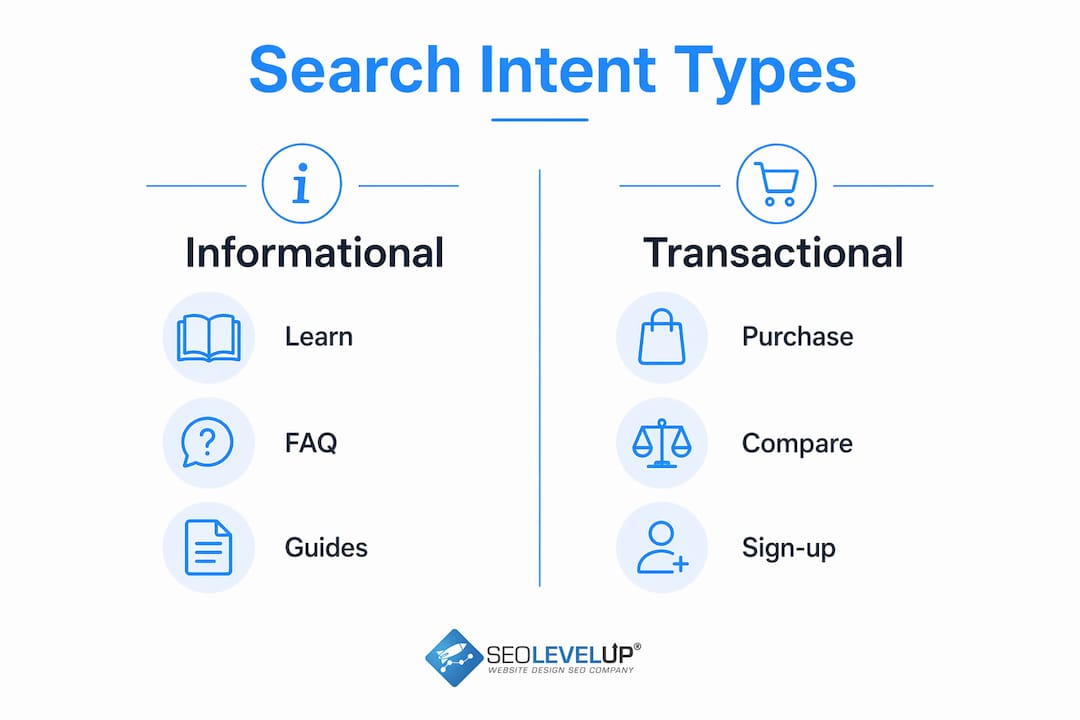
Google’s Search Quality Evaluator Guidelines classify intent into four types: Know, Do, Website, and Visit-in-person. The SEO industry maps these to four parallel categories that are easier to apply in practice.
| Intent Type | User Goal | Query Example | Best Content Format |
|---|---|---|---|
| Informational | Learn something | “how does SEO work” | Blog post, guide, FAQ |
| Navigational | Find a specific site | “Semrush login” | Brand landing page |
| Commercial | Research before buying | “best SEO tools 2026” | Comparison, review |
| Transactional | Complete an action | “buy Ahrefs subscription” | Product page, landing page |
Each type demands a different content format and a different page structure. Informational queries call for depth and clarity. Navigational queries call for fast, direct access to the right page. Commercial queries call for honest comparisons with clear differentiators. Transactional queries call for frictionless conversion paths with strong calls to action.
A few nuances are worth noting:
- Informational intent covers the widest range of queries. “What is schema markup,” “how to write a meta description,” and “why does my website rank drop” are all informational, but they require very different answers.
- Navigational intent is largely brand-driven. Competing for someone else’s navigational query is rarely worth the effort.
- Commercial intent is where most B2B and service businesses win or lose. Buyers in this stage are close to a decision and need trust signals.
- Transactional intent converts fastest. These pages need speed, clear pricing, and minimal friction.
Google’s “Visit-in-person” category adds a fifth practical layer for local businesses. A query like “coffee shop near me” signals that the user wants a physical location, not a blog post. This is where local SEO services and Google Business Profile optimization become directly tied to intent matching.
Why does aligning content with search intent matter for rankings?
Aligning pages with user intent builds trust and engagement, which leads to measurable SEO performance gains. Search engines use behavioral data to validate whether a page earned its ranking. A page that ranks for “how to do keyword research” but only sells a software tool will see high bounce rates. Google reads that signal and adjusts the ranking accordingly.
The impact on conversions is equally direct. A commercial intent page that reads like an informational article loses buyers at the moment they are ready to act. A transactional page that buries the purchase option behind paragraphs of background text creates friction that kills revenue. Matching format to intent is not a design preference. It is a conversion requirement.
Semantic search has raised the stakes further. Google no longer matches keywords in isolation. It interprets the full context of a query, including related entities, synonyms, and the implied goal behind the words. Semantic accuracy and structured content are now critical for pages targeting AI-driven and generative search results. This means your content needs to answer the question clearly, use related terms naturally, and organize information so both humans and algorithms can follow the logic.
Common mistakes marketers make when ignoring intent:
- Targeting high-volume informational keywords with product pages
- Writing blog posts for transactional queries instead of landing pages
- Ignoring commercial intent entirely and jumping straight to transactional content
- Treating all “how to” queries as identical when the implied depth varies widely
Pro Tip: Treat search intent as a filter before you evaluate keyword volume. Discard keywords that conflict with your site’s goals early, regardless of how much traffic they promise. This saves budget and keeps your content strategy focused.
How can you identify and analyze search intent for any keyword?
The most reliable method for identifying intent is to run the query yourself and read the SERP. Google’s results page is a direct signal of what intent the algorithm has assigned to that keyword. If the top results are all blog posts, the intent is informational. If they are all product pages, the intent is transactional. If they are a mix, the intent is likely commercial or mixed.
keyword research tools make this faster at scale:
- Semrush labels keywords with intent tags (Informational, Navigational, Commercial, Transactional) directly in its Keyword Overview and Keyword Magic Tool. You can filter entire keyword lists by intent type in seconds.
- Ahrefs shows SERP features and result types alongside keyword data, letting you infer intent from what Google is already ranking. Its Keywords Explorer also groups related queries by topic cluster.
- Yoast SEO (for WordPress users) includes intent guidance within its content analysis, prompting writers to confirm the page matches the intended query type before publishing.
Keyword modifiers are another fast signal. Words like “best,” “top,” and “vs.” indicate commercial intent. Words like “how,” “what,” and “why” indicate informational intent. Words like “buy,” “price,” and “near me” indicate transactional or local intent. These patterns are not perfect, but they give you a starting point before you check the SERP.
Many queries hold mixed intent, requiring hub content that links informational and commercial pages together. A query like “content marketing for small businesses” could serve someone learning the concept or someone ready to hire an agency. A hub page that addresses both and links to deeper resources captures the full user journey. You can apply this approach directly using a content marketing checklist to map your pages against intent types.
Pro Tip: Build a simple spreadsheet with three columns: keyword, SERP-observed intent, and current page type. Any row where the last two columns do not match is a ranking opportunity hiding in plain sight.
How to match content formats to search intent in 2026
Specific content formats correlate directly with different intent types. Choosing the wrong format is as damaging as targeting the wrong keyword. A detailed guide written for an informational query will outperform a thin FAQ every time. A focused landing page built for a transactional query will convert better than a blog post that happens to mention the product.
| Intent Type | Recommended Format | Key Elements |
|---|---|---|
| Informational | Long-form guide, FAQ, explainer | Clear headings, definitions, examples |
| Navigational | Brand page, login page | Fast load, direct access, minimal distraction |
| Commercial | Comparison article, review post | Pros and cons, trust signals, clear verdict |
| Transactional | Landing page, product page | Price, CTA, social proof, checkout path |
| Generative | Schema-marked FAQ, entity-rich content | Structured data, direct answers, entity stacking |
The generative intent row is new and growing fast. An emerging “Generative” search intent describes users who expect AI-generated direct answers rather than a list of links. Winning these results requires schema markup, entity-focused structure, and content that answers questions in the first sentence of each section. This is exactly how AI Overviews and Perplexity pull citations from pages.
For informational content, the goal is to answer the question completely and link to related commercial pages where relevant. For commercial content, the goal is to build enough trust that the reader clicks through to a transactional page. For transactional content, every element on the page should reduce friction between the reader and the conversion. Writing SEO content that performs across all three stages requires a clear intent map before a single word is written.
Intent is not static. Intent varies and includes implied or transactional aspects even within informational queries. A user searching “how to fix a slow website” may also be open to hiring someone to fix it. A page that answers the question and offers a free audit captures both the informational and the implied transactional intent at once. Layered content strategies that serve the primary intent first and the secondary intent second consistently outperform single-purpose pages.
Key Takeaways
Search intent is the single most important filter in SEO because it determines whether your content earns rankings, engagement, and conversions, or wastes budget on traffic that never converts.
| Point | Details |
|---|---|
| Search intent definition | Intent is the user’s primary goal behind a query, not just the words they typed. |
| Four core intent types | Informational, Navigational, Commercial, and Transactional cover 99% of all queries. |
| Intent before keywords | Filter keywords by intent before evaluating volume to avoid wasted content spend. |
| Format must match intent | Guides for informational, landing pages for transactional, comparisons for commercial. |
| Generative intent is rising | Schema markup and entity-rich structure are now required to win AI-generated results. |
Search intent is the gatekeeper, not a checkbox
I have audited hundreds of websites where the content calendar was built entirely around keyword volume. The pages ranked for nothing, not because the writing was bad, but because every piece was written for the wrong intent. A service business publishing “what is digital marketing” guides attracts students, not buyers. That traffic looks good in a dashboard and does nothing for revenue.
The shift I push every client to make is treating intent analysis as the first step, not an afterthought. Before you check search volume, ask what the person typing that query actually wants to do. If the answer does not connect to your business goal, move on. Discarding mismatched keywords early saves more budget than any bidding strategy.
The part most marketers miss is implied intent. A user searching “how long does SEO take” is not just curious. They are evaluating whether SEO is worth their time and money. A page that only answers the literal question misses the real opportunity. The best-performing pages I have seen answer the stated question in the first paragraph, then address the implied concern directly below it.
AI search has made this even more unforgiving. Gemini and ChatGPT do not reward pages that bury the answer. They cite pages that lead with the answer and support it with structured, entity-rich content. If your page does not satisfy intent in the first 30% of the content, it will not get cited. That is the new standard, and it rewards the same discipline that good intent analysis has always required.
— Tommy Seilheimer
How SEOLEVELUP can help you rank for the right searches
Understanding search intent is one thing. Building a website and content strategy that executes it consistently is another challenge entirely.
SEOLEVELUP, LLC Website Design SEO Company builds custom websites and content strategies around intent from the ground up. Every page is mapped to a specific intent type, structured for semantic clarity, and marked up with schema so it performs in both traditional Google results and AI-generated answers. Whether you need local SEO in Chicago or a national content strategy, the team at SEOLEVELUP aligns every deliverable with what your customers are actually searching for. Call (224) 600-4353 for a free SEO audit and find out exactly where your intent gaps are costing you rankings.
FAQ
What is search intent in simple terms?
Search intent is the reason behind a user’s search query. It tells you whether someone wants to learn something, find a specific website, compare options, or make a purchase.
What are the four types of search intent?
The four types are Informational, Navigational, Commercial, and Transactional. 99% of queries fall into one of these categories, making them the standard framework for SEO content planning.
How do I identify the search intent for a keyword?
Run the keyword in Google and read the top results. If the SERP shows blog posts, the intent is informational. If it shows product pages, the intent is transactional. Tools like Semrush and Ahrefs also label intent directly in their keyword data.
Why does search intent matter for SEO rankings?
Google measures engagement signals like dwell time and bounce rate to confirm whether a page satisfied the user’s goal. Pages that match intent earn better signals and hold rankings longer.
What is generative search intent?
Generative intent describes users who expect a direct AI-generated answer rather than a list of links. Content optimized for generative intent requires schema markup, entity-focused structure, and answers placed at the top of each section.


