

Competitive analysis SEO is defined as the systematic process of evaluating websites that rank for your target keywords to identify gaps in content, backlink profiles, technical health, and AI search visibility. The industry standard term for this practice is SEO competitor analysis, and it sits at the core of every high-performing search strategy. Unlike general business competitor research, this process focuses entirely on search intent and keyword overlap, not product similarity. Tools like Ahrefs, HubSpot, SEMrush, and SEObolt give you the data to understand exactly why competitors outrank you and what you need to do about it. This guide walks you through every layer of the process, from identifying your true SEO competitors to applying findings that move the needle on traffic and conversions.
What are the key steps in performing an SEO competitive analysis?
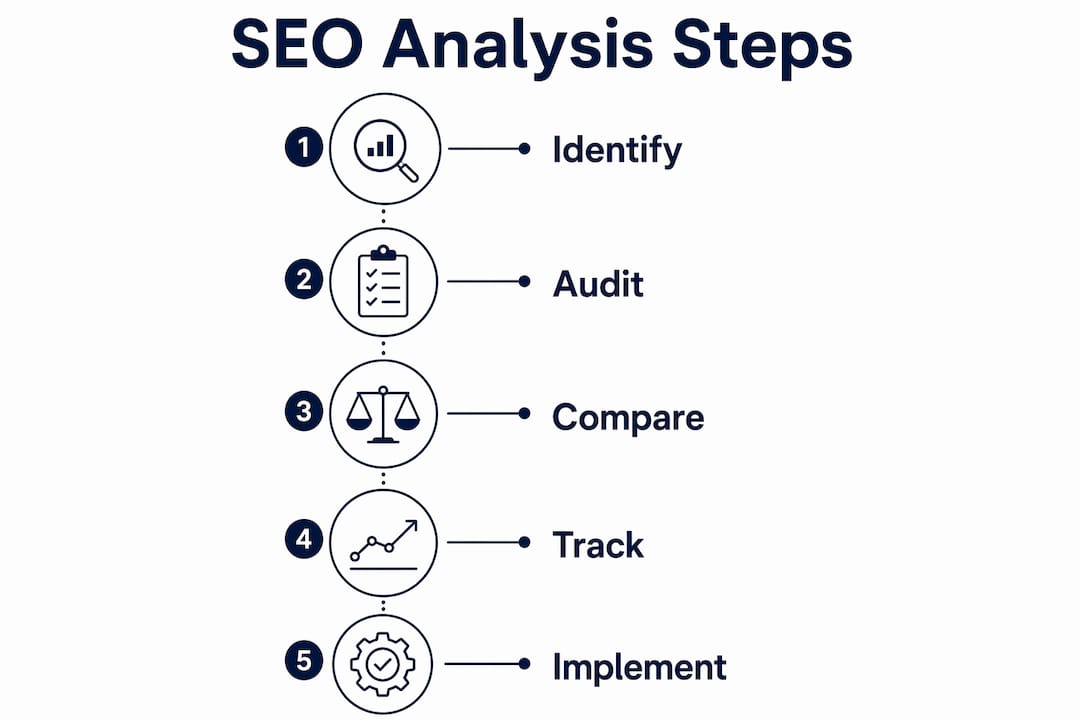
SEO competitor analysis involves identifying SEO competitors, investigating their traffic sources, finding content and keyword gaps, analyzing backlink profiles, and auditing technical and AI signals to build a prioritized action plan. The process is sequential, and skipping steps produces incomplete data. Here is how to execute it correctly.
-
Identify your true SEO competitors. Run your primary target keywords in Google and note which domains consistently appear in the top 10. These are your SEO competitors, and they may include industry blogs, news sites, or aggregators that share no business overlap with you. A local HVAC company, for example, may compete directly with national home improvement publications for informational queries like “how to fix a furnace.”
-
Conduct keyword gap analysis. Use a tool like Ahrefs or SEMrush to compare your keyword rankings against two or three top competitors. The gap report shows you every keyword a competitor ranks for that you do not. Prioritize gaps where the keyword has clear commercial or informational intent aligned with your business goals.
-
Analyze backlink profiles. Pull your competitors’ backlink data and identify the domains linking to them but not to you. These represent direct link-building opportunities. Focus on editorial links from authoritative publications, industry directories, and resource pages rather than low-quality link farms.
-
Evaluate content quality and format. Review the top-ranking pages for your target keywords. Note whether Google favors long-form guides, comparison tables, video embeds, or FAQ sections. Matching the format Google already rewards for a given query is one of the fastest ways to improve rankings without building a single new link.
-
Audit technical SEO and AI visibility. Check Core Web Vitals scores for your site versus competitors using Google Search Console and PageSpeed Insights. Beyond traditional technical factors, modern SEO audits now include evaluating entity clarity, topical authority, brand visibility in AI-powered search features, and structured data to enhance answer engine optimization (AEO).
-
Build a prioritized action plan. Rank your findings by potential traffic impact and implementation effort. Address technical fixes first since they affect every page, then move to content gaps, then link building.
Pro Tip: Set up a shared spreadsheet tracking competitor keyword positions weekly. Even a free tool like Google Search Console combined with manual SERP checks gives you a reliable baseline before you invest in premium software.
Which tools are essential for SEO competitor analysis in 2026?

Advanced SEO competitor analysis in 2026 requires premium tools to track numerous competitors, monitor daily keyword fluctuations, and compare AI-driven search visibility across engines like Perplexity, Gemini, and Claude. The tool you choose determines the depth of insight you can extract.
| Tool | Core strength | AI visibility tracking | Best for |
|---|---|---|---|
| Ahrefs | Backlink analysis, keyword gap | No | Link building and content gap research |
| SEMrush | All-in-one keyword and traffic data | Limited | Agencies managing multiple clients |
| Moz | Domain authority scoring | No | Brand authority benchmarking |
| HubSpot | Integrated marketing analytics | No | Teams already in the HubSpot ecosystem |
| SEObolt | Multi-domain ranking comparison, 5-bucket keyword matrix | Yes (ChatGPT, Claude, Gemini, Perplexity) | AI-era competitive visibility analysis |
SEObolt provides advanced features such as 5-bucket keyword matrices, gap discovery, position delta tracking, and AI search visibility scoring across the four major AI answer engines. This matters because a growing share of search queries now resolve inside AI-generated answers rather than traditional blue-link results. If your competitor appears in a Perplexity answer and you do not, that is a visibility gap that traditional rank trackers will never surface.
Free tools like Google Search Console, Google Trends, and the free tiers of Moz and Ubersuggest cover the basics for businesses with tight budgets. They reveal your own performance clearly but provide limited competitor data. For genuine competitive intelligence, a paid subscription to at least one platform is the practical standard.
Pro Tip: Do not subscribe to five tools at once. Start with one platform that covers keyword gaps and backlink analysis, use it for 90 days, then evaluate whether AI visibility tracking warrants adding a second tool like SEObolt.
How does SEO competitor analysis differ from business competitor analysis?
SEO competitors are defined by search intent and keyword overlap, not business model. A competitor in your market may rank for completely different queries, while a website in an unrelated industry may dominate every keyword you care about. This distinction changes your entire strategy.
Consider a regional accounting firm targeting the query “how to reduce small business taxes.” Its SEO competitors for that query include Forbes, NerdWallet, and accounting software blogs, none of which compete for the firm’s actual clients. Treating those publications as irrelevant because they are not business rivals is a costly mistake. Many businesses mistakenly define competitors by market or business model rather than search intent, which leads to overlooking the websites actually capturing their potential traffic.
The practical implications of this distinction include:
- Broader content benchmarking. You must evaluate content quality against publishers and media sites, not just direct service providers.
- Different link-building targets. If a national blog ranks above you, studying its backlink profile reveals the editorial standards and source types you need to match.
- Search intent alignment over product similarity. A page that answers a question better than yours will outrank you regardless of how superior your product is.
- Entity-based competitive thinking. Competitive analysis should shift from ranking data toward entity-based insights to understand topical authority as a chessboard overview rather than isolated ranking pieces. Google increasingly rewards sites that demonstrate deep expertise on a topic cluster, not just individual keyword matches.
Understanding this separation between SEO competitors and business competitors is what separates reactive SEO from a deliberate, traffic-building strategy. You can use entity stacking tactics to build the kind of topical authority that outperforms both business rivals and media competitors in search results.
What actionable insights can you gain from SEO competitive analysis?
Analyzing competitor backlink profiles and content strategies helps identify link and content opportunities that lead to better organic rankings and visibility in search results. The data is only useful, however, when you translate it into specific, sequenced actions.
-
Fill keyword gaps with targeted content. Every keyword a competitor ranks for that you do not is a documented traffic opportunity. Build or optimize pages specifically for those queries, matching the format and depth Google already rewards for each one.
-
Replicate high-value backlink sources. If three of your competitors have earned links from the same industry publication or resource directory, that source is clearly open to your niche. Pitch it directly with a stronger or more current resource.
-
Match SERP feature formats. If the top result for your target keyword uses a numbered list and a comparison table, your page needs those same structural elements. Google’s featured snippet selection is heavily format-dependent.
-
Prioritize technical fixes using competitor benchmarks. If your Core Web Vitals scores lag behind the top three competitors for a keyword, that gap is a measurable ranking disadvantage. Use SEO audit tools to identify and fix page speed, mobile usability, and structured data issues.
-
Incorporate competitor PPC data. The keywords your competitors bid on in paid search reveal which queries convert for them. If a competitor consistently bids on a keyword you rank organically for, that is a signal the query drives real revenue, not just traffic.
-
Monitor competitor movements continuously. A competitor dropping from position 3 to position 15 for a key term is an opening. A competitor suddenly ranking for 50 new keywords signals a content push you need to respond to.
Pro Tip: Connect your competitive findings to Google Search Console data before acting. Combining competitor data with internal analytics connects SEO findings with actual business outcomes such as conversions, rather than just chasing ranking metrics. A keyword gap means nothing if the traffic it generates does not convert for your business model.
Key takeaways
Competitive analysis SEO requires identifying true search competitors by keyword overlap, auditing their content and backlinks, and translating those findings into prioritized actions tied to measurable business outcomes.
| Point | Details |
|---|---|
| Define SEO competitors by keyword overlap | Your SEO competitors are the sites ranking for your target queries, not just your business rivals. |
| Use the right tools for the depth you need | Ahrefs and SEMrush cover traditional gaps; SEObolt adds AI visibility tracking across ChatGPT, Claude, and Perplexity. |
| Prioritize technical fixes first | Core Web Vitals and structured data issues affect every page and should be addressed before content or link work. |
| Tie findings to business outcomes | Combine competitor data with Google Search Console to prioritize actions that drive conversions, not just rankings. |
| Monitor competitors continuously | Search landscapes shift fast; weekly position tracking and content monitoring let you respond before traffic drops. |
Why most SEO competitive analysis stops short of real impact
I have reviewed hundreds of SEO audits and competitive reports over the years, and the pattern is consistent. Businesses invest in the analysis, collect the data, and then act on the most visible finding, usually a keyword gap or a missing backlink, without connecting any of it to revenue. The report becomes a document rather than a decision-making tool.
The shift I consider most significant right now is the move toward AI-driven search visibility. Traditional rank tracking tells you where you appear in Google’s blue-link results. It tells you nothing about whether your brand surfaces in a ChatGPT answer, a Perplexity summary, or a Gemini overview. Integrating competitor SEO insights with internal analytics ensures prioritization based on business impact rather than vanity metrics, and that principle applies directly to AI visibility. If your competitor is being cited by AI answer engines and you are not, you are losing a channel that does not show up in your rank tracker at all.
My practical recommendation is to treat competitive analysis as a quarterly process, not a one-time project. Markets shift, competitors publish new content, and Google’s algorithm updates redistribute rankings regularly. The businesses I have seen sustain long-term search growth are the ones that treat competitor monitoring as an ongoing operational function, not a pre-launch checklist item. Pair your external competitive data with your SEO checklist to keep internal and external signals aligned.
— Tommy
How Seolevelup turns competitive analysis into search dominance
Understanding competitive analysis SEO is the foundation. Executing it consistently at scale is where most businesses need expert support.

Seolevelup’s team of Google SEO specialists delivers managed local SEO services that include full competitor analysis, technical SEO audits, content gap identification, and AI search visibility assessments. Every strategy is built on verifiable data, not assumptions. If you want to know exactly why competitors outrank you and receive a prioritized plan to close that gap, Seolevelup provides the transparent reporting and expert execution to make it happen. For businesses also running paid search, Seolevelup’s SEM services integrate competitive keyword intelligence across both organic and paid channels for a unified growth strategy.
FAQ
What is competitive analysis SEO?
Competitive analysis SEO is the systematic process of evaluating websites that rank for your target keywords to identify gaps in content, backlinks, technical performance, and AI search visibility. The goal is to use those findings to build a prioritized strategy that improves your own rankings and organic traffic.
How do I identify my SEO competitors?
Search your primary target keywords in Google and record which domains consistently appear in the top 10 results. These are your SEO competitors regardless of whether they sell competing products, since SEO competition is determined by keyword overlap and search intent, not business model.
Which SEO competitive analysis tools are most effective?
Ahrefs and SEMrush are the standard choices for keyword gap analysis and backlink research. SEObolt adds AI visibility tracking across ChatGPT, Claude, Gemini, and Perplexity, which is increasingly relevant as AI-generated answers capture a growing share of search traffic.
How often should I perform an SEO competitor analysis?
A full competitive analysis should be conducted quarterly, with lighter weekly monitoring of keyword position changes and competitor content activity. Search rankings shift frequently, and timely data lets you respond to competitor moves before they affect your traffic.
What is the difference between SEO competitors and business competitors?
Business competitors sell similar products or services to the same customers. SEO competitors are any websites ranking for your target keywords, including blogs, publishers, and aggregators that may have no commercial overlap with your business at all.


