

Digital marketing is defined as the use of online channels, including search engines, social media, email, and paid advertising, to create awareness, convert prospects, and retain customers at scale. The role of digital marketing in growth is not optional for small to medium-sized businesses in 2026. The global digital advertising market reached $456.7 billion in 2025 and is projected to surpass $1.2 trillion by 2034. That trajectory reflects how completely digital channels have replaced traditional media as the primary engine of business growth. Tools like Google Analytics 4 and Meta Business Suite now give even the smallest businesses the data precision that was once reserved for enterprise marketing teams.
How digital marketing drives growth: core mechanisms
Digital marketing creates awareness, converts interest, and retains customer value to produce compounding business growth over time. Each mechanism reinforces the next, which is why businesses that invest consistently outperform those that run one-off campaigns. Here is how the core process works:
-
Awareness creation. Organic search, paid ads, and social media put your business in front of people who have never heard of you. Google Search ads, for example, appear at the exact moment a user types a relevant query, capturing intent-driven traffic that cold outreach cannot match.
-
Conversion. Awareness alone does not pay the bills. Targeted landing pages, retargeting campaigns, and clear calls to action turn visitors into leads and leads into paying customers. A well-structured Google Ads campaign paired with a conversion-optimized landing page can cut cost per acquisition by a measurable margin within weeks.
-
Retention and upsell. Email marketing and content programs keep existing customers engaged and buying again. Email marketing generates $45 for every $1 spent, making it the highest-ROI channel for retention. That return dwarfs what most businesses see from print mailers or broadcast advertising.
-
Data compounding. Every campaign generates data. Better data produces sharper audience segments, which improve targeting, which lowers cost per click, which frees budget for more testing. The cycle accelerates over time, rewarding businesses that stay consistent.
Pro Tip: Identify your single biggest growth constraint before allocating budget. If your website converts at 1%, spending more on traffic is wasteful. Fix the conversion problem first, then scale the spend.
Paid ads vs. SEO vs. social vs. email: which channel grows your business?

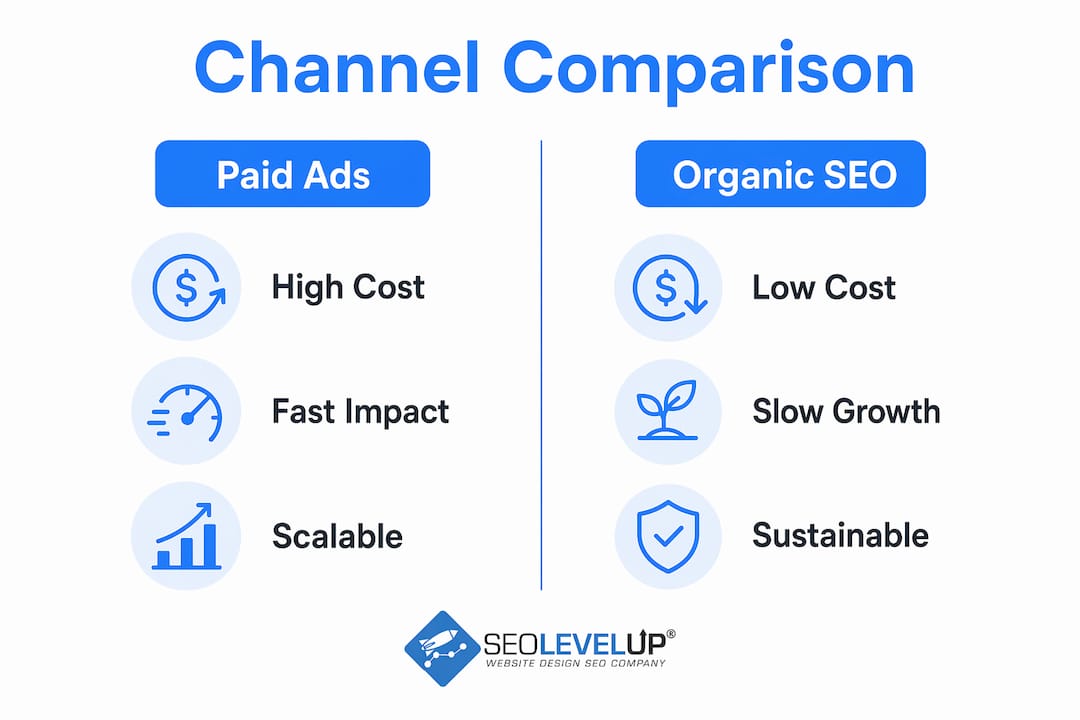
No single channel wins for every business. The impact of digital marketing depends heavily on which channels you choose and how well you match them to your growth stage. The table below compares the four primary digital marketing strategies for growth across the dimensions that matter most to SMBs.
| Channel | Upfront Cost | Time to Impact | Scalability | Best Use Case |
|---|---|---|---|---|
| Paid Ads (PPC/SEM) | Medium to high | Days | High, budget-dependent | Fast lead generation, product launches |
| Organic Search (SEO) | Low to medium | 3–6 months | Very high over time | Long-term traffic, authority building |
| Social Media Marketing | Low | Weeks | Medium | Brand awareness, community engagement |
| Email Marketing | Very low | Days to weeks | High | Lead nurturing, repeat purchases, upsell |
Paid advertising through platforms like Google Ads and Meta Ads delivers immediate reach and precise audience targeting. The tradeoff is that traffic stops the moment your budget runs out. SEO builds authority and sustainable organic traffic over months, but the results compound and persist long after the initial investment. Social media marketing on platforms like Instagram, LinkedIn, and Facebook costs relatively little and builds community, but organic reach on most platforms has declined sharply, making a small paid amplification budget worth considering. Email marketing sits in a category of its own because it operates on an owned list, meaning you are not renting attention from a platform.
Pro Tip: Match your channel mix to your growth stage. Early-stage businesses often benefit most from paid ads for speed and SEO for long-term foundation. Established businesses should weight email and content more heavily to maximize customer lifetime value.
Why digital marketing outperforms traditional marketing for smbs
Traditional marketing, meaning print, radio, TV, and direct mail, was built for large budgets and broad audiences. Digital marketing was built for precision, and that difference is decisive for SMBs. Digital channels offer lower cost, sharper targeting, real-time measurement, and scalability that traditional methods simply cannot match.
Here is what that means in practice for your business:
- Budget flexibility. You can start a Google Ads campaign for $300 per month or a Facebook campaign for $10 per day. Traditional TV or radio buys require commitments that most SMBs cannot sustain.
- Precise audience targeting. Digital marketing enables precise targeting of high-intent audiences, reducing wasted spend. You can target by zip code, age, income, search behavior, and purchase history simultaneously.
- Real-time optimization. Google Analytics 4 and Meta Business Suite show you which ads are working within hours, not months. You can pause underperforming campaigns and redirect budget before significant money is lost.
- Owned asset building. Digital marketing builds owned assets like email lists, social followings, and content libraries that reduce dependency on paid channels over time. A 10,000-person email list is an asset that generates revenue on demand.
- Competitive reach. Smaller businesses successfully use digital marketing to compete with larger brands by focusing on niche audiences and efficient budget allocation. A local HVAC company with a strong local SEO presence and active Google Business Profile can outrank a national chain in its own market.
The importance of digital marketing for SMBs comes down to one fact: it removes the budget as the primary barrier to competitive visibility. Strategy and execution matter more than spend.
How to implement digital marketing strategies that actually drive growth
Knowing the channels is not enough. Execution separates businesses that grow from those that spin their wheels. Follow these steps to build a digital marketing program that produces measurable results.
-
Define your growth goal clearly. Are you trying to generate leads, increase e-commerce sales, or grow repeat business? Your goal determines your channel priority. Vague goals produce vague results.
-
Set up measurement before you spend. Install Google Analytics 4 on your website and connect it to your Google Ads account before launching any campaign. Without proper tracking, you cannot attribute revenue to specific channels, and you will make budget decisions based on guesswork. The role of analytics in SEO extends to every digital channel you run.
-
Prioritize channels by audience behavior. If your customers search for your service on Google, SEO and paid search are your highest-priority channels. If your audience spends time on Instagram or LinkedIn, social media marketing deserves early investment. Use digital marketing tips specific to your market to avoid generic channel selection.
-
Build content that serves both SEO and social. A well-researched blog post can rank on Google, get shared on LinkedIn, and be repurposed into an email newsletter. Content that serves multiple channels multiplies your return on each piece produced.
-
Run paid ads with a testing mindset. Launch with two or three ad variations, measure click-through rate and conversion rate separately, and cut the underperformers within two weeks. Measurement tools like Google Analytics 4 and Meta Business Suite make this process straightforward when set up correctly.
-
Build your email list from day one. Offer a lead magnet, a discount, or a free resource in exchange for an email address. Every subscriber you add is a direct line to a customer that no algorithm change can take away.
-
Audit before you scale. Review your analytics monthly. Identify which channel drives the most revenue per dollar spent, then increase that budget before touching anything else.
Pro Tip: Before doubling your ad spend, run a conversion audit on your landing pages. Most SMBs lose more money to poor conversion rates than to insufficient traffic.
Key takeaways
Digital marketing drives measurable business growth by combining precise targeting, real-time data, and owned asset building across channels that traditional marketing cannot replicate.
| Point | Details |
|---|---|
| Digital marketing fuels compounding growth | Awareness, conversion, and retention work together to accelerate results over time. |
| Email delivers the highest ROI | At $45 returned per $1 spent, email marketing outperforms every other digital channel for retention. |
| SMBs can outcompete larger brands | Focused strategy and precise targeting matter more than budget size in digital channels. |
| Owned assets reduce long-term costs | Email lists and organic search rankings compound in value and reduce paid media dependency. |
| Measure before you scale | Diagnosing what works before increasing spend prevents wasted budget and accelerates growth. |
Digital marketing is a system, not a campaign
I have worked with hundreds of SMBs across Chicagoland, and the pattern I see most often is this: a business owner runs a few Facebook ads, gets inconsistent results, and concludes that digital marketing does not work for their industry. That conclusion is almost always wrong. The problem is not the channel. The problem is treating digital marketing as a series of disconnected campaigns rather than an integrated system.
Digital marketing capabilities like analytics, CRM, and social media engagement are strategic innovation drivers for SMBs, not just promotional tools. The businesses I have seen grow most consistently are the ones that treat their Google Analytics 4 dashboard with the same seriousness they treat their profit and loss statement. They know their cost per lead, their conversion rate by channel, and their customer lifetime value. That knowledge lets them make confident decisions instead of reactive ones.
The other mistake I see constantly is spreading budget across every channel at once. A $2,000 monthly marketing budget split six ways produces mediocre results everywhere. That same $2,000 concentrated on the one channel where your customers are most active produces results you can actually build on. Identify your primary growth constraint, fix it, then expand.
The businesses that will win in 2026 are not the ones with the biggest budgets. They are the ones that treat digital marketing as a core business function, measure it honestly, and improve it systematically. That is not a prediction. It is what the data already shows.
— Tommy Seilheimer
Ready to turn digital marketing into real growth?
If you are ready to stop guessing and start growing, SEOLEVELUP, LLC Website Design SEO Company builds the digital marketing systems that produce verifiable results for SMBs across Chicagoland and nationwide. From custom website design built for conversion to managed local SEO services that get you found in Google and AI-powered search, every service is tied to measurable growth outcomes. We back our work with transparent reporting, not just rankings.
Call SEOLEVELUP, LLC Website Design SEO Company at (224) 600-4353 for a free SEO audit, or visit seolevelup.com to see how we help businesses like yours compete and win online.
FAQ
What is the role of digital marketing in business growth?
Digital marketing drives growth by creating awareness through search and social channels, converting visitors into customers through targeted campaigns, and retaining customers through email and content programs. Each function compounds over time, producing accelerating returns when executed consistently.
How does email marketing compare to other digital channels for ROI?
Email marketing generates an average of $45 for every $1 spent, making it the highest-ROI digital channel available to SMBs. No other channel consistently delivers that return at scale.
Can small businesses compete with larger brands using digital marketing?
Yes. Smaller businesses successfully compete with larger brands by focusing on niche audiences, precise targeting, and efficient budget allocation. Strategy and execution matter more than total spend in digital channels.
What digital marketing strategies work best for SMB growth?
The most effective combination for SMBs is organic search (SEO) for long-term traffic, paid search for immediate lead generation, and email marketing for retention. The right mix depends on your growth stage, audience behavior, and budget.
How do you measure the impact of digital marketing on business growth?
Use Google Analytics 4 to track traffic sources, conversion rates, and revenue attribution by channel. Connect it to Meta Business Suite for social campaign data. Measure cost per lead and customer lifetime value monthly to make confident budget decisions.


