

Natural language processing in SEO is defined as the technology that enables search engines to interpret the meaning, context, and intent behind both queries and content, moving far beyond simple keyword matching. Google’s BERT and MUM models process queries contextually, which means the same page can now rank for dozens of related queries you never explicitly targeted. For digital marketers, SEO specialists, and business owners, understanding what is natural language processing SEO is no longer optional. It is the foundation of every ranking decision Google makes in 2026.
What is natural language processing SEO and why does it matter?
Natural language processing, or NLP, is a branch of artificial intelligence that teaches machines to read, parse, and understand human language. In the context of SEO, NLP is the engine behind semantic search. It is what allows Google to understand that “best running shoes for flat feet” and “top sneakers for overpronation” are asking the same question.
Semantic search shifts SEO focus from keyword density to meaning and context. That shift is not subtle. It means a page stuffed with exact-match keywords but lacking depth will consistently lose to a page that thoroughly addresses a topic from multiple angles. The practical implication for you is that writing for NLP means writing for people first, then confirming the structure is machine-readable.

NLP also powers the Google Knowledge Graph, which maps relationships between entities. When Google reads your page, it is not just scanning for words. It is identifying named entities, their relationships, and how prominently each one appears. That process determines how your content gets categorized and ranked.
Core natural language processing techniques that affect your rankings
NLP techniques like tokenization, syntactic and semantic analysis, and named entity recognition directly shape how search engines process and rank your content. Each technique plays a distinct role in how Google reads a page.
- Tokenization breaks your text into individual units, words, phrases, or sentences, so the algorithm can analyze each component. A sentence like “Chicago SEO agency” gets split into tokens that Google then evaluates for meaning and relationship.
- Syntactic analysis examines sentence structure and grammar. Google uses this to confirm that your content is coherent and that subject-verb-object relationships make logical sense.
- Semantic analysis goes deeper, identifying the meaning behind words and how concepts relate to each other. This is why writing about “mortgage rates” on a page about “home buying” reinforces topical relevance.
- Named entity recognition (NER) identifies specific people, places, organizations, and concepts within your text. Google uses NER to map your content against the Knowledge Graph.
- Sentiment analysis evaluates the tone of your content. Sentiment analysis and entity recognition help search engines evaluate tone and identify key entities to improve ranking accuracy.
Understanding search intent signals is the practical output of all these techniques working together. When your content aligns with how NLP reads language, you rank for the right queries.
Pro Tip: Run your draft through Google’s Natural Language API demo before publishing. It shows you exactly which entities Google extracts from your page and their salience scores, giving you a clear picture of whether your intended topic registers as the primary subject.
How Google’s NLP pipeline processes your webpage
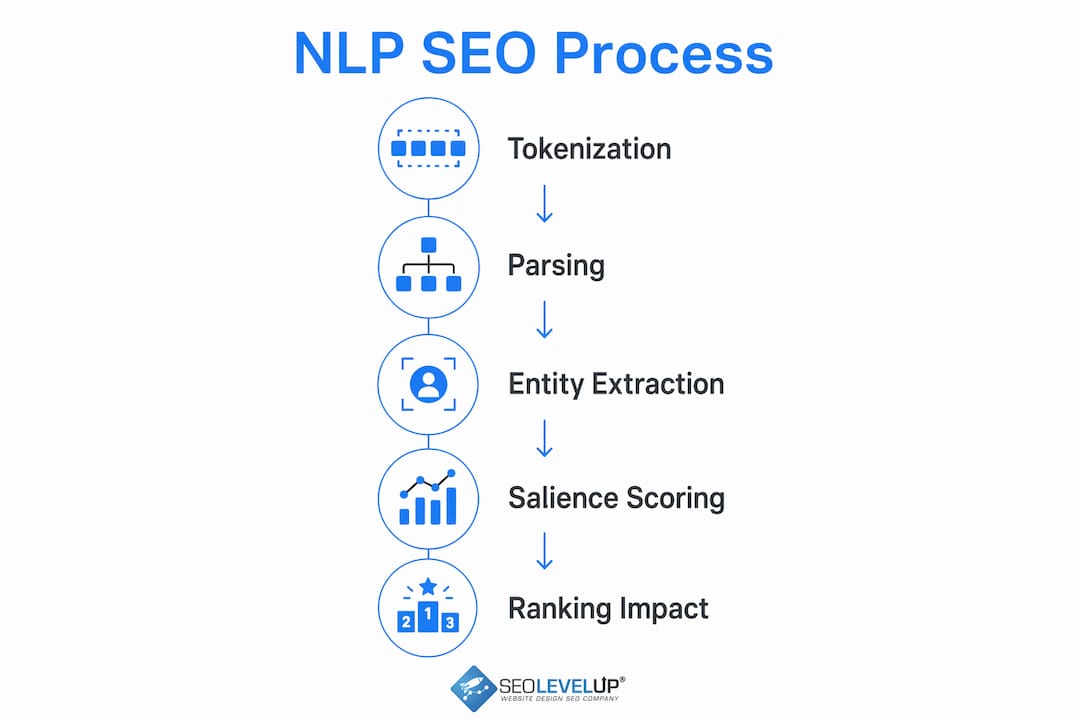
Google’s NLP pipeline includes sequential stages: tokenization, parsing, entity extraction, and salience scoring. Failing an early stage like parsing renders your content semantically invisible, regardless of how well-written it is.
Here is how each stage works and what can go wrong:
| Pipeline Stage | What Google Does | Common SEO Failure |
|---|---|---|
| Tokenization | Splits text into words and phrases | Broken HTML disrupts token boundaries |
| Parsing | Analyzes grammatical structure | Passive voice overuse confuses sentence logic |
| Entity extraction | Identifies named entities | Vague pronoun references prevent entity resolution |
| Salience scoring | Ranks entity prominence on the page | Off-topic sections dilute your primary entity score |
| Intent matching | Maps content to searcher intent | Misaligned headings signal wrong topic category |
The distinction between NLP and NLU is critical here. NLP handles mechanical text processing, while NLU, natural language understanding, extracts intent, resolves entities against the Knowledge Graph, and matches searcher intent. NLP prepares the data. NLU decides what it means. Your content must pass both tests.
Entity salience scoring influences which topics Google perceives as most important on your page. If your primary keyword or entity is not the most salient element, Google can misinterpret your page’s core topic entirely. That misinterpretation costs you rankings on the queries you care about most.
Pro Tip: Keep your primary entity prominent throughout the page, not just in the title and first paragraph. Mention it in subheadings, image alt text, and the conclusion. Consistent entity prominence raises your salience score.
Practical strategies to optimize content using NLP principles
Keyword stuffing is obsolete. Algorithms now reward content that thoroughly covers topics and answers adjacent user queries with semantic depth. The following steps translate NLP principles into concrete writing and structure decisions.
-
Build topical depth, not keyword frequency. Write content that addresses the full scope of a topic, including related subtopics, common questions, and adjacent concepts. Search engines analyze entire topic clusters rather than isolated keywords, rewarding expertise and detailed coverage.
-
Use schema markup to clarify entity relationships. Schema tells Google explicitly what type of entity your page is about. An Article schema with a defined author entity, a publisher entity, and a subject entity gives the NLU layer clear signals that reduce ambiguity.
-
Answer related questions within the body. Include H3 subheadings that address the questions your audience actually types into search. This directly feeds the NLU intent-matching stage and increases your chances of appearing in featured snippets.
-
Write in clear, unambiguous language. Avoid pronouns that lack clear antecedents. Instead of “it helps with this,” write “schema markup helps Google resolve entity relationships.” Specificity aids entity resolution at the NER stage.
-
Structure content for semantic search relevance. Use your primary entity in the title, the first paragraph, at least two subheadings, and the conclusion. Distribute related entities naturally throughout the body.
“Content marketers should shift focus from keyword density to thorough coverage and answering user questions, as NLP evaluates semantic and syntactic relevance.” — Flying Cat Marketing
Content optimization guided by NLP principles produces pages that rank for broader query sets without requiring separate pages for every keyword variation. That efficiency compounds over time.
How NLP affects SEO strategy and rankings in 2026 and beyond
The impact of NLP on SEO strategy is accelerating. Google’s BERT and MUM models are now deeply embedded in the ranking algorithm, and their influence on content visibility is direct and measurable.
- BERT (Bidirectional Encoder Representations from Transformers) reads words in context, both before and after each token, to understand nuanced meaning. A query like “can you get a visa for Brazil without a sponsor” is now parsed with full contextual awareness, not just keyword matching.
- MUM (Multitask Unified Model) goes further, processing text, images, and video simultaneously across multiple languages. MUM can answer complex, multi-part queries by synthesizing information from multiple sources.
- Advanced NLP allows ranking for queries never explicitly targeted by identifying concepts and entity relationships. A well-structured page about “content marketing strategy” can rank for “how to plan a blog editorial calendar” without those exact words appearing anywhere.
- Generative AI search features, including Google’s AI Overviews, pull answers directly from pages that score well on NLU intent matching. Optimizing for NLP is now also optimizing for AI citation.
- Syntactic and semantic AI increasingly determine content visibility. Pages that rely on keyword repetition without semantic depth are losing ground to pages built around entity relationships and topical authority.
The role of machine learning in SEO will only grow. Marketers who build NLP-aware content workflows now will hold a structural advantage as these models continue to evolve.
Key takeaways
Natural language processing in SEO requires building content around entity relationships, topical depth, and clear intent signals rather than keyword frequency.
| Point | Details |
|---|---|
| NLP moves beyond keywords | Google uses BERT and MUM to understand meaning, context, and intent in every query. |
| Pipeline stages determine visibility | Content that fails tokenization or parsing never receives semantic ranking benefits. |
| Entity salience drives topic interpretation | Your primary entity must be the most prominent on the page or Google misreads your topic. |
| Topical depth beats keyword density | Algorithms reward pages that cover a subject thoroughly, including adjacent questions and subtopics. |
| NLU is the intent layer | NLU resolves entities against the Knowledge Graph and matches content to searcher intent, not just text. |
Why most SEO content still fails the NLP test
After years of working in SEO, the pattern I see most often is this: marketers understand that keyword stuffing is dead, but they replace it with a different mistake. They write long content that covers the surface of a topic without ever going deep enough to satisfy the NLU layer.
A 2,000-word article that mentions “local SEO” forty times but never explains how proximity signals, Google Business Profile categories, and citation consistency interact will score poorly on entity salience and topical depth. Google’s pipeline will extract the entity “local SEO,” assign it a moderate salience score, and rank the page accordingly, which is to say, not very high.
The fix is not more words. The fix is tighter entity relationships and genuine question coverage. When I audit content that is underperforming, the most common issue is not a technical one. It is that the page answers the headline question but ignores the three follow-up questions a real reader would have. Those follow-up questions are exactly what NLU is looking for.
The other mistake I see constantly is treating schema markup as optional. Schema is not a bonus. It is the explicit signal that removes ambiguity from the NLU stage. If your page is about a service, a product, or a local business, schema markup is the difference between Google guessing your entity type and Google knowing it.
My honest recommendation: audit your top ten pages using Google’s Natural Language API. Look at which entities score highest in salience. If the top entity is not your intended topic, your content structure needs work before any other optimization will move the needle.
— Tommy Seilheimer
How SEOLEVELUP, LLC Website Design SEO Company builds NLP-ready content
Understanding NLP principles is one thing. Executing them consistently across an entire website is another challenge entirely. SEOLEVELUP, LLC Website Design SEO Company builds custom websites and SEO strategies designed from the ground up to perform in NLP-driven search environments. Every page is structured for entity clarity, topical depth, and intent alignment, so Google’s pipeline reads your content exactly as intended.

SEOLEVELUP, LLC Website Design SEO Company serves businesses across Chicagoland with managed local SEO services that incorporate schema markup, semantic content architecture, and Google Business Profile optimization. With 165+ five-star reviews and features on ESPN1000, the results are verifiable. Call (224) 600-4353 for a free SEO audit and find out exactly where your content stands in Google’s NLP pipeline.
FAQ
What is natural language processing in SEO?
Natural language processing in SEO is the technology that allows search engines to understand the meaning, context, and intent behind content and queries, rather than matching isolated keywords. Google uses NLP models like BERT and MUM to process every search and every webpage.
How does BERT affect my SEO rankings?
BERT reads words in full context, both before and after each token, so it understands nuanced query meaning. Pages that address a topic with depth and clear entity relationships perform better under BERT than pages built around keyword repetition.
What is the difference between NLP and NLU in search?
NLP handles the mechanical processing of text, including tokenization and parsing. NLU, natural language understanding, extracts intent, resolves entities against the Google Knowledge Graph, and matches content to what the searcher actually wants.
How do I optimize content for NLP-driven search?
Focus on thorough topical coverage, clear entity relationships, and schema markup. Address related subtopics and user questions within the body, and keep your primary entity prominent throughout the page to score well on salience.
Does schema markup help with NLP optimization?
Schema markup gives Google explicit signals about your entity type and relationships, removing ambiguity from the NLU stage. For local businesses, service pages, and articles, schema is a direct factor in how accurately Google interprets and ranks your content.


