

Mobile SEO is the primary factor determining search visibility in 2026, and every digital marketer, SEO professional, and business owner needs to treat it as the foundation of their search strategy. Mobile devices generate 67.4% of global web traffic, making the desktop experience a secondary concern for Google. The role of mobile SEO in 2026 extends far beyond responsive design. It now covers content parity, Core Web Vitals measured under real-world conditions, and AI-driven search behavior that originates almost entirely from mobile devices. 53% of mobile visits are abandoned when a page takes longer than 3 seconds to load. That single number tells you what is at stake.
What is the role of mobile SEO in 2026?
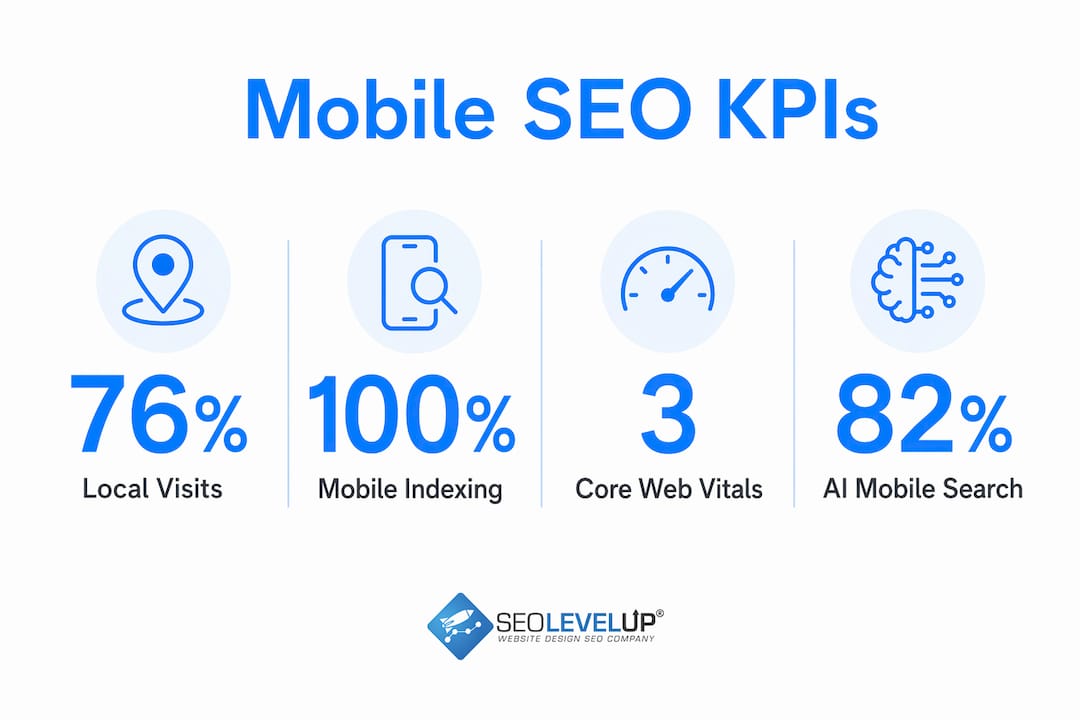
Mobile SEO is the practice of optimizing your website so Google’s mobile crawler can fully index, understand, and rank your content. The industry standard term is mobile search engine optimization, and it now governs desktop rankings too. Google completed mobile-first indexing for all sites by october 2023, meaning Googlebot Smartphone is the primary crawler and desktop evaluation is legacy only. Your desktop site’s ranking depends entirely on the quality of your mobile site.
This shift has real consequences for how you build and maintain content. If your mobile version is missing text, internal links, or structured data that appears on desktop, Google treats your site as thin. That classification triggers ranking penalties and reduces your visibility across all devices. Mobile SEO is no longer a separate workstream. It is the workstream.
The practical stakes are high for local businesses too. 76% of local mobile searches result in a store visit within 24 hours. That connection between mobile search and physical foot traffic makes mobile SEO steps one of the highest-return investments a local business can make.

Why does content parity matter for mobile-first indexing?
Mobile SEO has evolved beyond responsive design to require full content parity and semantic completeness on the mobile version of every page. Content parity means your mobile site must contain every element your desktop site contains: all body text, all internal links, all image alt text, and all structured data markup. Missing any of these on mobile causes Google to rank you based on an incomplete picture of your site.
Common content parity failures include:
- Hidden text on mobile that appears in desktop accordions but is not rendered for Googlebot Smartphone
- Missing schema markup on mobile templates, which eliminates rich result eligibility
- Truncated navigation links that break internal link equity on mobile
- Desktop-only content blocks that contain keyword-rich copy Google never sees on mobile
Each of these failures has a direct ranking consequence. Google does not give credit for content it cannot crawl on mobile. Structured data that exists only on your desktop template does not generate rich results. You can learn more about how structured data affects rankings and why consistency across both versions is non-negotiable.
Pro Tip: Focus on meaning completeness over pixel-perfect design. A mobile page that renders all your content in a single column outperforms a visually polished page that hides half its text behind JavaScript.
How do Core Web Vitals affect mobile rankings?
Core Web Vitals are Google’s primary performance ranking signals, and they are measured using real mobile field data, not lab simulations. Core Web Vitals thresholds are based on field data from actual mobile users, reflecting real network conditions and device capabilities. A site that scores well in Google PageSpeed Insights under ideal conditions can still fail in the field if real users on mid-range phones experience slow load times.
The metric that matters most in 2026 is Interaction to Next Paint (INP), which replaced First Input Delay as a Core Web Vitals signal. INP measures how quickly a page responds to every user interaction, not just the first tap. On mobile, where JavaScript execution is slower and touch events are the primary input, INP scores are consistently worse than on desktop. Improving INP requires reducing JavaScript execution time, deferring non-critical scripts, and minimizing layout shifts triggered by ads or dynamic content.
To improve your real-world mobile Core Web Vitals, follow this sequence:
- Collect field data using Google Search Console’s Core Web Vitals report, which shows real user measurements by device type
- Identify your LCP element and confirm it is not lazy-loaded. Lazy-loading the hero image on mobile directly harms your Largest Contentful Paint score
- Audit third-party scripts that fire on page load, since these are the most common cause of poor INP on mobile
- Compress and serve next-gen image formats like WebP or AVIF to reduce payload on mobile connections
- Test on a mid-range device that is 2–3 years old to simulate the experience of your actual users, not your development machine
Pro Tip: Test your site speed on a mid-range Android device using Google Chrome’s DevTools throttling set to “Slow 4G.” This simulates the conditions most of your real mobile visitors experience.
How does AI-driven mobile search change SEO strategy?
AI search assistants account for 82.1% of launches from mobile devices as of Q1 2026. That figure reshapes what mobile SEO optimization means. You are no longer just optimizing for Googlebot Smartphone. You are also optimizing for AI crawlers from ChatGPT, Perplexity, and Google’s own AI Overviews, all of which primarily access content through mobile rendering paths.
“Mobile SEO is the foundation of organic search success in 2026, as desktop rankings depend fully on mobile site quality.” — WhatsonTech
The implications for content structure are significant:
- Semantic HTML matters more than ever. AI crawlers parse heading hierarchy, list structure, and paragraph meaning to extract answers. Flat, unstructured mobile pages get skipped.
- Snippet quality determines AI citation. Pages with clear, direct answers in the first paragraph of each section are more likely to appear in AI Overviews and Perplexity answers.
- Zero-click behavior is accelerating on mobile. Users get answers directly in the SERP or AI interface without visiting your site. Optimizing for zero-click searches means structuring content so your brand appears in the answer even when the click never happens.
- Rich results require mobile-valid schema. If your FAQ, HowTo, or Product schema is missing from your mobile template, you are ineligible for rich results in both traditional and AI-enhanced SERPs.
The future of mobile SEO runs directly through AI search behavior. Sites that structure their mobile content for both human readers and AI crawlers will capture a disproportionate share of visibility.
Practical mobile SEO techniques that work in 2026
Effective mobile optimization in 2026 requires a systematic approach across technical performance, content structure, and local search. Google penalizes sites with poor mobile experience through Core Web Vitals and usability signals, which directly lowers rankings and increases bounce rates. The following areas produce the highest return when addressed together.
Technical performance:
- Serve images in WebP or AVIF format and size them for mobile viewports
- Eliminate render-blocking resources in the
<head>tag - Use a CDN to reduce latency for mobile users across geographic regions
- Never lazy-load your LCP image. This is the single most common technical mistake on mobile pages
Content and structure:
- Audit every page for content parity between desktop and mobile using Google Search Console’s URL Inspection tool
- Confirm all schema markup renders correctly on mobile using Google’s Rich Results Test
- Write concise, direct answers at the top of each section to improve snippet eligibility
Local SEO for mobile:
- Keep your Google Business Profile fully updated, since most “near me” searches happen on mobile
- Use location-specific schema on service pages to improve local mobile rankings
- Build local SEO strategies that target mobile searchers with intent to visit or call
| Optimization area | Priority | Primary tool |
|---|---|---|
| Core Web Vitals (field data) | Critical | Google Search Console |
| Content parity audit | Critical | URL Inspection Tool |
| LCP image optimization | High | PageSpeed Insights |
| Schema markup on mobile | High | Rich Results Test |
| Local mobile visibility | High | Google Business Profile |
| INP and JavaScript audit | Medium | Chrome DevTools |
Pro Tip: Prioritize mobile usability and navigation alongside speed. A fast page that is hard to tap through on a small screen still produces high bounce rates and poor engagement signals.
Key takeaways
Mobile SEO is the single most important factor in search rankings in 2026 because Google indexes and ranks all sites based on mobile content quality, performance, and structure.
| Point | Details |
|---|---|
| Mobile-first indexing is universal | Google crawls all sites as Googlebot Smartphone; desktop evaluation is no longer used for ranking. |
| Content parity is non-negotiable | Your mobile version must include all text, links, and schema markup present on desktop. |
| Core Web Vitals use real field data | Measure performance using actual mobile user data, not lab scores from fast devices. |
| AI search launches from mobile | 82.1% of AI assistant launches come from mobile, requiring semantic structure for AI crawlers. |
| Local mobile search drives revenue | 76% of local mobile searches lead to a store visit within 24 hours, making local mobile SEO high-priority. |
Mobile SEO in 2026: my honest assessment
I have worked with businesses across Chicagoland and nationally, and the pattern I see repeatedly is the same. Teams invest in desktop content, desktop design, and desktop analytics, then wonder why their rankings are flat. The answer is almost always sitting in their mobile experience.
The shift that most marketers have not fully absorbed is that mobile SEO is not a checklist item anymore. It is the primary lens through which Google evaluates your entire site. When I audit a site and find that the mobile version is hiding content in collapsed tabs or missing schema that exists on desktop, I know exactly why that site is underperforming. The fix is not complicated, but it requires deliberate attention.
What I find most underestimated is the local mobile opportunity. A business that ranks well for mobile “near me” searches and has a complete Google Business Profile is capturing customers at the exact moment they are ready to act. That is not a future trend. That is happening right now, and most small businesses are leaving that traffic on the table.
The AI dimension adds a new layer that I take seriously. Optimizing for Googlebot Smartphone is table stakes. Optimizing your semantic structure so that ChatGPT and Perplexity can extract and cite your content is where the next wave of visibility will come from. The businesses that treat mobile SEO as a living, ongoing process will compound their search advantage over the next two years. The ones that treat it as a one-time project will fall behind.
— Tommy Seilheimer
How SEOLEVELUP can improve your mobile search performance

SEOLEVELUP, LLC Website Design SEO Company builds mobile-optimized websites that are engineered for Core Web Vitals compliance, full content parity, and AI crawler compatibility from day one. Every site we build is tested on real mobile devices, not just desktop browsers, and backed by structured data implementation that supports rich results across Google, ChatGPT, and Perplexity. Our managed local SEO services target the mobile “near me” searches that drive foot traffic and phone calls for Chicagoland businesses. If your mobile performance is holding back your rankings, call us at (224) 600-4353 for a free SEO audit.
FAQ
What is mobile-first indexing and why does it matter?
Mobile-first indexing means Google uses your mobile site as the primary version for crawling and ranking. Google completed this transition for all sites by october 2023, so your desktop rankings now depend entirely on your mobile site quality.
How do Core Web Vitals affect mobile SEO rankings?
Core Web Vitals are direct Google ranking signals measured using real mobile user data. Poor scores for Largest Contentful Paint, Cumulative Layout Shift, or Interaction to Next Paint lower your rankings and increase bounce rates.
What is content parity in mobile SEO?
Content parity means your mobile site contains all the text, links, images, and structured data present on your desktop site. Missing content on mobile causes Google to rank you based on an incomplete version of your pages.
How does AI search change mobile SEO strategy?
AI search assistants launch from mobile devices 82.1% of the time, so your mobile content must be structured semantically for AI crawlers like those used by ChatGPT and Perplexity, not just for Googlebot Smartphone.
How can local businesses benefit from mobile SEO?
76% of local mobile searches lead to a store visit within 24 hours. Local businesses that rank well for mobile searches and maintain a complete Google Business Profile capture customers at the highest point of purchase intent.


