

Increasing website traffic is defined as growing the number of qualified visitors to your site through a coordinated mix of SEO, content marketing, paid advertising, and digital engagement. Most businesses see measurable SEO results within 3–6 months of consistent effort, while paid ads and community outreach can deliver visitors within days. The strategies that work in 2026 go beyond basic keyword targeting. They require technical readiness, topic authority, AI search optimization, and conversion-focused page design. Tools like Google Search Console, SEMrush, Ahrefs, and Google Ads are the core instruments for executing and measuring every channel in this guide.
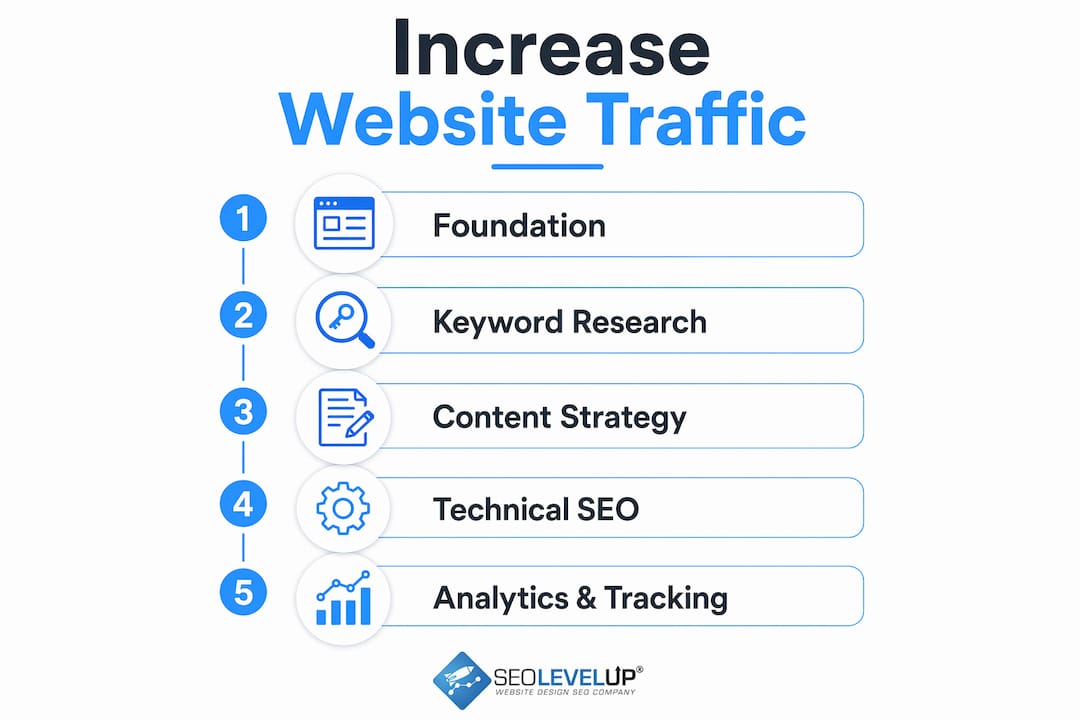
How to increase website traffic: build the right foundation first
Before you run a single ad or publish a single blog post, your website must be ready to receive and convert visitors. A slow, broken, or poorly structured site wastes every dollar and hour you invest in traffic growth.
Technical performance and infrastructure
Your site needs three non-negotiable qualities: fast load speed, mobile responsiveness, and HTTPS security. Google’s Core Web Vitals score directly affects your search rankings. Use Google PageSpeed Insights or GTmetrix to identify load time issues before launching any traffic campaign.

keyword research and user intent
keyword research is the process of identifying the exact phrases your audience types into Google, Bing, or AI tools like ChatGPT and Perplexity. Tools like Google Keyword Planner, SEMrush, and Ahrefs each show search volume, keyword difficulty, and related queries. The most important filter is user intent: are searchers looking to buy, learn, or compare? Match your page type to that intent.
Analytics and tracking setup
You cannot improve what you do not measure. Install Google Analytics 4 and Google Search Console before driving any traffic. Add UTM parameters to every campaign URL so you can trace visitors back to their exact source, whether that is a Google Ads click, an email newsletter, or a Reddit post.
Here is a quick-reference table for the foundational tools every business needs:
| Tool | Primary Function | Best For |
|---|---|---|
| Google Search Console | Organic search performance | Tracking impressions and clicks |
| Google Analytics 4 | Traffic source and behavior data | Conversion and engagement tracking |
| SEMrush or Ahrefs | keyword research and competitor gaps | Content planning and backlink analysis |
| Google PageSpeed Insights | Site speed and Core Web Vitals | Technical performance audits |
| Google Keyword Planner | Search volume and CPC data | Paid and organic keyword targeting |
Pro Tip: Set up a Google Analytics 4 custom report that segments traffic by channel (organic, paid, referral, email) from day one. This single report will tell you which channels deserve more budget and which need to be cut.
Which SEO and content strategies drive long-term organic traffic?
Sustainable organic traffic growth comes from building topical authority, not chasing individual keywords. The businesses that win in search are the ones Google and AI engines recognize as the most complete resource on a subject.
Topic clusters and pillar pages
Organizing your content into topic clusters is the single most effective structural change you can make. Topic clusters drive about 30% more organic traffic than standalone keyword targeting. That number reflects a fundamental shift in how Google evaluates relevance. A pillar page covers a broad topic in depth, while cluster pages address specific subtopics and link back to the pillar. This internal linking structure signals authority to search engines and keeps visitors on your site longer. Content clusters with strong internal linking also deliver 2.5x longer-lasting rankings than isolated posts. That longevity means your investment compounds over time rather than decaying after a few months.
Optimizing for AI and voice search
Modern SEO must account for how people ask questions to Google Assistant, Siri, and AI tools like ChatGPT and Gemini. Conversational SEO is critical for capturing zero-click and voice-driven traffic in 2026. Write content that answers specific questions in plain language. Use FAQ sections, schema markup, and natural phrasing like “how do I” and “what is the best way to” rather than stiff keyword strings. You can learn more about this shift in our guide on zero-click search optimization.
Technical SEO and backlink building
A technical SEO audit covers crawlability, indexation, duplicate content, broken links, and Core Web Vitals. Run a full audit using Screaming Frog or Ahrefs Site Audit at least twice per year. For backlinks, guest posting on industry publications and digital PR campaigns are the two most reliable methods. A single link from a high-authority domain like Forbes, HubSpot, or an industry trade publication carries more weight than dozens of low-quality directory links.
Here is a comparison of content approaches by traffic impact and timeline:
| Strategy | Traffic Type | Time to Results | Longevity |
|---|---|---|---|
| Topic cluster with pillar page | Organic | 3–6 months | 2+ years |
| Standalone blog post | Organic | 2–4 months | 6–12 months |
| Guest post with backlink | Referral + organic | 1–3 months | Ongoing |
| AI/voice search optimization | Organic + zero-click | 2–5 months | Long-term |
Pro Tip: When building your first topic cluster, start with a subject where you already have 3–5 existing blog posts. Retrofit those posts as cluster pages, write a new pillar page, and add internal links. You will see ranking improvements without writing everything from scratch.
What are the fastest ways to generate immediate website traffic?
Long-term SEO is non-negotiable, but you also need traffic now. Fast channels work best when they run in parallel with your organic strategy, not as a replacement for it.
- Google Ads and paid search: Targeting high-intent keywords through Google Ads delivers traffic within days. Start with exact-match keywords that signal purchase or service intent, such as “Chicago web design company” or “emergency plumber near me.” Set a modest daily budget of $20–$50 to test messaging before scaling.
- Community engagement on Reddit and Quora: Participating in niche subreddits and Quora threads where your audience already gathers drives targeted referral visits. The key is adding genuine value first. Answer questions thoroughly, then reference your content only when it directly answers the question.
- Email marketing to your existing list: Email marketing drives repeat, direct traffic reliably without depending on any algorithm. A single well-timed email to a list of 1,000 engaged subscribers can generate more qualified visits than a week of social media posts.
- Short-form video on TikTok, Instagram Reels, and YouTube Shorts: Short-form video content increases top-of-funnel awareness and drives traffic when paired with a focused landing page link. A 60-second video explaining a common problem in your industry, with a link to your full guide, is a proven format.
- Social media posts with direct links: LinkedIn works particularly well for B2B businesses. Posting a data-driven insight with a link to the full article consistently outperforms generic promotional content.
Pro Tip: Use a small paid traffic test of $100–$200 on Google Ads or Meta Ads to validate your messaging before committing to a full content or SEO campaign. If the paid traffic converts, the organic version of that same message will too.
How do you measure traffic quality and improve conversions?
More visitors mean nothing if they leave without taking action. Traffic volume is a vanity metric. Success depends on traffic quality, conversion likelihood, and whether your pages validate your offer.
- Audit your landing pages before driving traffic. Check every page for a clear headline, a specific offer, and a visible call to action. Sending traffic to unoptimized pages causes high bounce rates and wastes your budget. Fix the page first, then promote it.
- Track traffic by channel in Google Analytics 4. Look at bounce rate, average engagement time, and goal completions for each source. Organic traffic from a well-ranked blog post often converts at a higher rate than paid traffic because the visitor’s intent is already aligned with your content.
- Segment by quality, not just volume. A page that receives 500 visits with a 40% conversion rate is more valuable than one with 5,000 visits and a 1% conversion rate. Build custom segments in Google Analytics 4 to isolate your highest-converting traffic sources.
- Run A/B tests on headlines, CTAs, and page layouts. Continuous A/B testing on these three elements consistently improves conversion rates over time. Tools like Google Optimize or VWO make this process straightforward for most business owners.
- Refresh underperforming content regularly. Update statistics, add new examples, and improve internal linking on posts that rank on page two of Google. A content refresh often moves a post from position 15 to position 5 without writing anything new from scratch.
Pro Tip: Check your 2026 SEO checklist quarterly to catch technical issues and content gaps before they cost you rankings.
Key takeaways
The most effective way to increase website traffic is to combine a technically sound site, topic-cluster content, and fast-channel promotion while measuring quality over volume at every step.
| Point | Details |
|---|---|
| Build the foundation first | Fix site speed, mobile performance, and analytics before running any traffic campaign. |
| Use topic clusters for organic growth | Pillar pages with internal linking drive 30% more organic traffic than standalone posts. |
| Run fast channels in parallel | Google Ads, email, and community engagement deliver visitors while SEO compounds. |
| Measure quality, not just volume | Track conversions by channel to identify which traffic sources actually grow your business. |
| Optimize pages before promoting them | Unoptimized landing pages waste traffic; audit headlines and CTAs before scaling spend. |
Traffic is a tool, not a trophy
I have worked with hundreds of business owners who come to us focused entirely on the wrong number. They want more visitors. What they actually need is more customers. Those are not the same thing, and confusing them leads to expensive mistakes.
The businesses I have seen grow fastest are the ones that treat traffic as a validation tool. They run a small paid test, confirm the message converts, then invest in the organic version of that same strategy. They do not wait 12 months for SEO to kick in before finding out their offer does not resonate.
The other pattern I see consistently is businesses investing in traffic before their site is ready. A beautiful homepage with no clear call to action, a blog with no internal links, a contact form that does not work on mobile. These are conversion killers that no amount of traffic will fix. Audit your pages first. Every time.
The SEO landscape in 2026 has also shifted in ways that reward businesses willing to think beyond Google’s blue links. AI-driven answers in ChatGPT, Gemini, and Perplexity are now a real traffic source. The businesses getting cited in those answers are the ones with well-structured, authoritative content that answers specific questions directly. That is exactly what the 2026 SEO update guide covers in detail.
Mix your channels, fix your pages, and measure what converts. That is the framework that actually works.
— Tommy Seilheimer
Ready to grow your traffic with expert help?
Knowing the strategy is one thing. Executing it consistently while running a business is another challenge entirely. SEOLEVELUP, LLC Website Design SEO Company builds fast, custom websites and backs them with full-service SEO, local SEO, and content strategy designed to attract the right visitors and turn them into customers.
From technical SEO and keyword research to custom website design that converts, SEOLEVELUP, LLC Website Design SEO Company handles every layer of your traffic growth strategy. Trusted with 165+ five-star reviews and heard on ESPN1000, we focus on results you can measure. Call (224) 600-4353 for a free SEO audit and find out exactly where your traffic is being lost.
FAQ
How long does it take to increase organic website traffic?
Most websites see measurable organic traffic growth within 3–6 months of consistent SEO work. Paid advertising and community engagement can deliver visitors within days for faster initial results.
What is the most effective strategy for long-term traffic growth?
Topic clusters with pillar pages and internal linking are the most effective long-term strategy. They drive approximately 30% more organic traffic than standalone posts and produce rankings that last significantly longer.
Do i need to run paid ads to increase website traffic?
Paid ads are not required, but they accelerate results while organic SEO builds. A small Google Ads test of $100–$200 also validates your messaging before you invest in a full content campaign.
How do i know if my website traffic is actually working?
Track conversions by channel in Google Analytics 4, not just total visitor counts. Quality traffic produces measurable actions like form submissions, calls, or purchases, not just page views.
What is the difference between SEO and GEO for traffic growth?
SEO targets traditional search engine rankings on Google and Bing. GEO, or Generative Engine Optimization, targets AI-driven answers in tools like ChatGPT and Gemini. Both are now necessary to capture the full range of search-driven traffic in 2026.


